How Often Should You Exfoliate After 40? Your Questions, Answered
Quick Answer: Most skin over 40 does well with chemical exfoliation two to three times per week, not daily. Turnover does slow with age - roughly from a month-long cycle in your twenties to noticeably longer by your forties - but the barrier also becomes more fragile and slower to repair, so aggressive frequency causes more damage than the extra turnover is worth. Start at once weekly and build.
The most common over-40 skin complaint - dullness that will not lift - is caused by over-exfoliation about as often as by under-exfoliation.
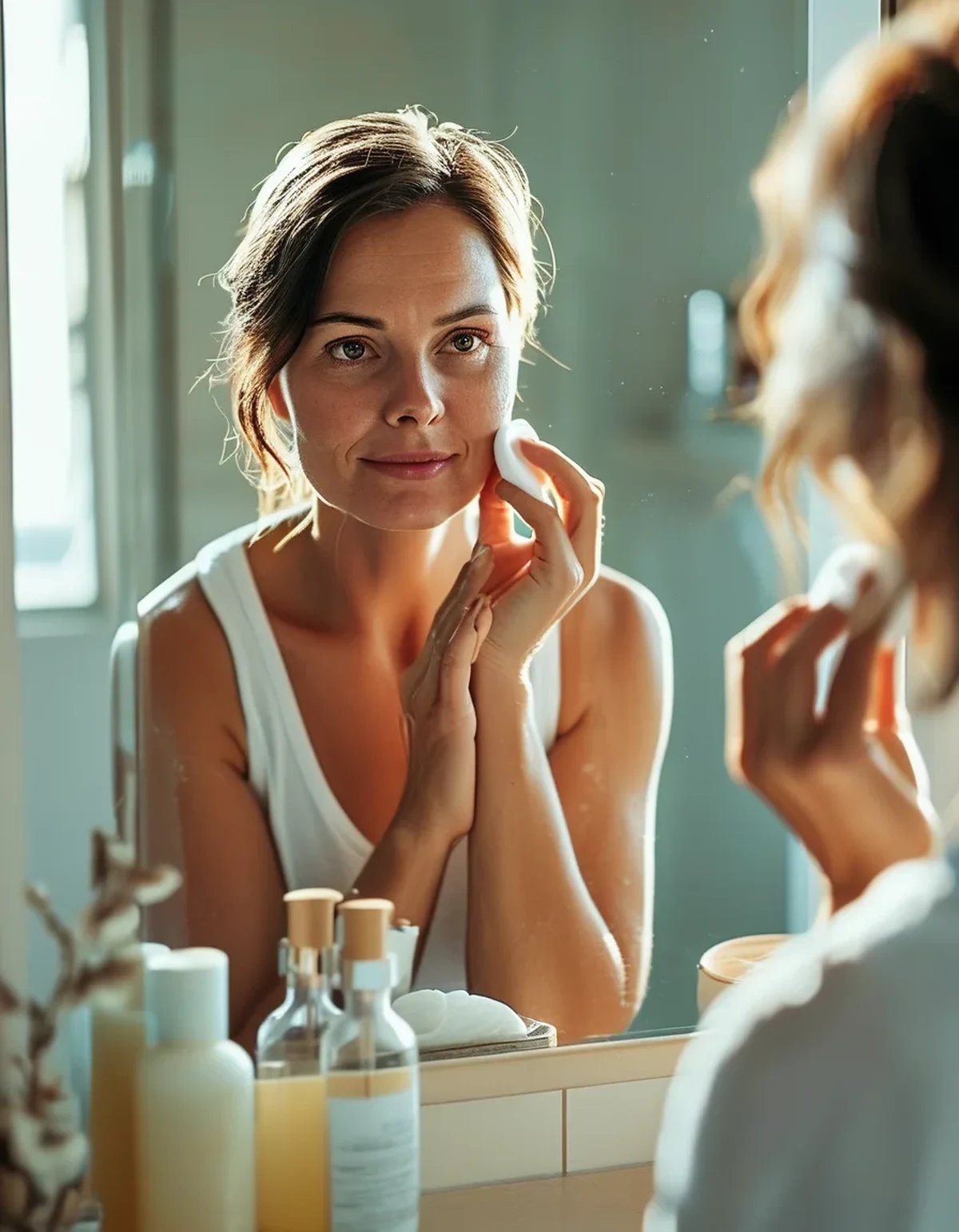
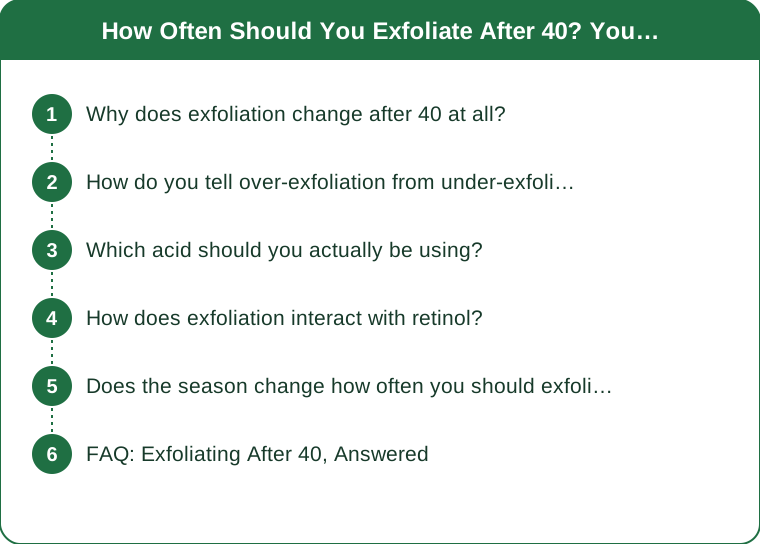
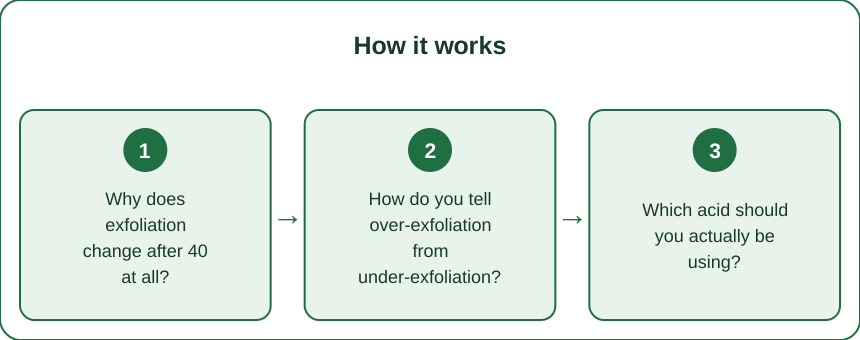
Why does exfoliation change after 40 at all?
Because two things move in opposite directions at the same time, and the routine that worked at 30 accounts for only one of them.
Turnover slows. In your twenties, skin cells make the journey from the base of the epidermis to the surface in roughly four weeks. That cycle lengthens progressively with age, and by your forties it takes meaningfully longer. Dead cells linger, sit less evenly, and scatter light rather than reflecting it. That is the dullness people notice, and it is a genuine argument for helping the process along.
The barrier gets more fragile. Skin produces less sebum and fewer of the lipids - ceramides, cholesterol, fatty acids - that hold the outer layer together and keep water in. Falling estrogen through perimenopause accelerates this. So the same barrier that needs help shedding is also less able to withstand having that help forced on it, and it repairs more slowly when damaged.
That combination is the whole story. Slower turnover says exfoliate. Weaker barrier says exfoliate gently, and less often than you think.
What this rules out is the intuitive response - if turnover is slower, exfoliate more. Frequency is not the lever that compensates for slower turnover. Choosing the right acid, at the right concentration, applied consistently over months, is. A well-tolerated twice-weekly routine sustained for a year outperforms an aggressive routine that has to be abandoned every six weeks to repair the damage.
How do you tell over-exfoliation from under-exfoliation?
They produce overlapping symptoms, which is why so many people respond to over-exfoliation by exfoliating more.
Both cause dullness. Both can cause flaking. Both make skin look worse than it should. The distinguishing signs:
Over-exfoliation:
- Skin feels tight immediately after cleansing and stays tight
- A shiny or waxy look rather than a healthy glow - a compromised barrier reflects light differently
- Stinging from products that never used to sting, especially vitamin C or anything with alcohol
- Redness that lingers, or new sensitivity to temperature changes
- Paradoxical oiliness, as skin overproduces oil to compensate for a damaged barrier
- Small bumpy texture across the cheeks that is not acne
Under-exfoliation:
- Dullness with no tightness or stinging - skin feels comfortable, just flat
- Makeup sits on top and looks patchy or cakey
- Products seem to sit on the surface rather than absorbing
- Visible flaking that comes away easily and is not accompanied by irritation
The single most useful test: does anything sting? Comfortable dull skin is under-exfoliated. Stinging, tight, or reactive dull skin is over-exfoliated, and the answer is to stop entirely for two weeks.
That two-week pause is worth taking seriously. A damaged barrier over 40 takes longer to rebuild than it did at 25, and continuing to exfoliate through it extends the problem indefinitely. During the pause: a gentle cleanser, a moisturizer with ceramides, sunscreen, and nothing else active. Most skin recovers visibly within two weeks and fully within four.
Which acid should you actually be using?
The choice matters more than the frequency, and it changes with age for reasons beyond simple strength.
Glycolic acid has the smallest molecule of the common AHAs, so it penetrates fastest and deepest. That makes it the most effective on sun damage and uneven tone, and the most likely to irritate. Over 40 it remains useful but is often better at a modest concentration used twice weekly than at a high concentration used occasionally.
Lactic acid is the quiet workhorse for mature skin. Larger molecule, slower penetration, gentler - and it is also a humectant, so it draws water into skin while exfoliating. For skin that is both dull and dry, which describes a great many people over 40, lactic acid addresses both at once. This is the sensible starting point for most people reading this.
Mandelic acid is larger still and the gentlest of the group. Worth knowing about for genuinely sensitive or reactive skin, or for anyone who has tried glycolic and lactic and reacted to both.
Salicylic acid is oil-soluble, so it works inside pores rather than only on the surface. If congestion and blackheads are part of the picture - and hormonal shifts in the forties bring these back for many people - salicylic addresses something the AHAs do not.
Polyhydroxy acids are the largest molecules, sit almost entirely on the surface, and are the most tolerable option available. Less dramatic results, but genuinely usable on compromised skin.
What about scrubs? Physical exfoliation is not forbidden, but it becomes a poorer trade with age. Thinner, more fragile skin is easier to microtear, and the results are shallower than a well-chosen acid delivers. A soft washcloth is about as physical as most over-40 routines need to get.
How does exfoliation interact with retinol?
This is where most over-40 routines go wrong, because both are doing overlapping work and the combined load is easy to underestimate.
Retinol accelerates cell turnover from within, prompting skin to shed faster. Acids dissolve the bonds between surface cells so shedding happens more easily. Different mechanisms, same outcome - and using both aggressively means the barrier is being challenged from two directions at once.
The symptoms of that overload are exactly the over-exfoliation list above, and because people attribute them to retinol, the usual response is to push through a “purge” that is not a purge at all. Actual retinoid purging is an acne flare from accelerated turnover clearing existing congestion. Barrier damage from combining retinol with too much acid is stinging, tightness, redness, and rough texture. Those are different problems with opposite solutions.
A structure that works for most skin over 40:
- Retinol on two or three evenings per week, alone, with moisturizer
- Acid exfoliation on one or two different evenings, never the same night as retinol when starting out
- At least one evening with neither - a recovery night with only moisturizer
- Sunscreen every morning, non-negotiable with either ingredient
Once that has been comfortable for several months, some people tolerate layering. Many never need to. The results people want from combining aggressively are available from consistency instead, and consistency does not cost you a month of recovery every time you overshoot.
One more interaction worth flagging: if you use prescription tretinoin, treat the acid budget as much smaller. Tretinoin is doing considerably more turnover work than over-the-counter retinol, and many people on it need no separate chemical exfoliant at all.
Does the season change how often you should exfoliate?
Yes, and late summer into autumn is the specific transition that catches people out.
Through summer, humidity supports the barrier - moist air slows water loss from skin, so a routine that would be too aggressive in January often feels fine in July. Then humidity drops, indoor heating starts, and the same routine becomes too much. Skin that was comfortable in August starts stinging in October, and the routine did not change - the environment did.
The other late-summer factor is accumulated sun exposure. Even with diligent sunscreen, months of higher UV leave skin with more surface damage and a barrier that has been working harder. Autumn is genuinely the best time of year to address pigmentation and texture, since UV levels are falling and exfoliated skin is more photosensitive - but it is also the moment your barrier is least resilient. Those two facts argue for starting a considered autumn routine gently rather than launching straight into intensive treatment.
A reasonable seasonal approach:
- Late summer: hold steady, add moisture, do not increase frequency yet
- Early autumn: if skin has been comfortable for a month, this is when to introduce or slightly increase acid use
- Deep winter: reduce frequency, prioritize barrier support, expect to tolerate less than in summer
- Spring: rebuild gradually as humidity returns
The general rule: let comfort set the frequency rather than the calendar. If skin is comfortable and dull, you have room. If it is comfortable and glowing, you are at the right frequency. If it stings, you are past it, whatever the season.
FAQ: Exfoliating After 40, Answered
Can I use an acid toner every day if it is low strength?
Some people can, but it is not the default worth assuming. Low-strength daily products still add up, and daily use leaves no recovery window. If daily use is comfortable for a month and skin looks better rather than shinier and tighter, it is working. Any stinging means back to two or three times weekly.
Should I exfoliate before or after cleansing?
After cleansing, on dry or barely damp skin, before serums and moisturizer. Damp skin increases penetration and therefore irritation, so if you are sensitive, let skin dry fully for a few minutes first - a simple way to reduce intensity without changing product.
Will exfoliating help with the fine lines that appeared in my forties?
Modestly and indirectly. Exfoliation improves surface texture and light reflection, which makes fine lines less visible, and consistent AHA use over months supports collagen to some degree. It does not do what a retinoid does for lines. Realistic sequencing: sunscreen first, retinoid second, exfoliation third.
Do I still need this if I am already using a prescription retinoid?
Usually not much. Tretinoin drives substantial turnover on its own and most people on it need little or no additional chemical exfoliation. If your dermatologist has you on one, ask them before adding acids - the combination is manageable but should be deliberate rather than accidental. This is general information, not medical advice.
TL;DR:
- Turnover slows after 40 but the barrier also weakens - the answer is better acids used consistently, not more frequent exfoliation.
- Two to three times weekly suits most skin; start at once weekly and build only if skin stays comfortable.
- Stinging, tightness, or waxy shine means over-exfoliation - stop for two weeks and rebuild with ceramides and sunscreen.
- Lactic acid is the sensible default for skin that is both dull and dry; salicylic if congestion is part of the picture.
- Never stack acid and retinol on the same night when starting, and keep at least one recovery evening each week.
If your dull skin also stings, you are exfoliating too much - and adding more is the most common mistake of the decade. This is general information, not medical advice; see a dermatologist for persistent reactions.
Keep Reading
This article is for general informational and styling purposes only. Fit, sizing, and product availability may vary.