Why Your Skin Looks Better on Holiday and Worse the Week You Get Back
Quick Answer: Holiday skin improves mainly because of higher ambient humidity, more sleep, lower stress hormones, more water intake, and a simplified routine using fewer active ingredients. After 40 the barrier is more reactive and slower to recover, so it responds more visibly to all five. Four of the five are reproducible at home - the humidity, the sleep, the simplification, and the hydration. What is not reproducible is the sun exposure, which improves appearance short term and is the one variable working against you long term.
A week away and your skin looks like it did a decade ago. Ten days back home and it looks tired, dull, and mildly annoyed with you.
The variables that changed are identifiable, and most of them are not about the destination.
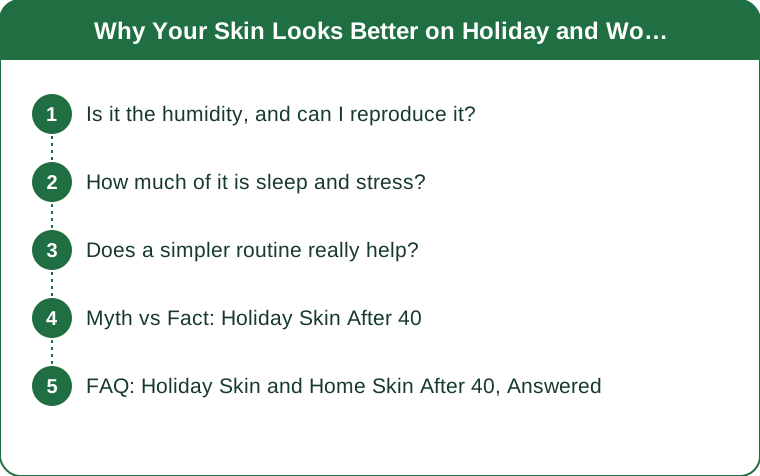
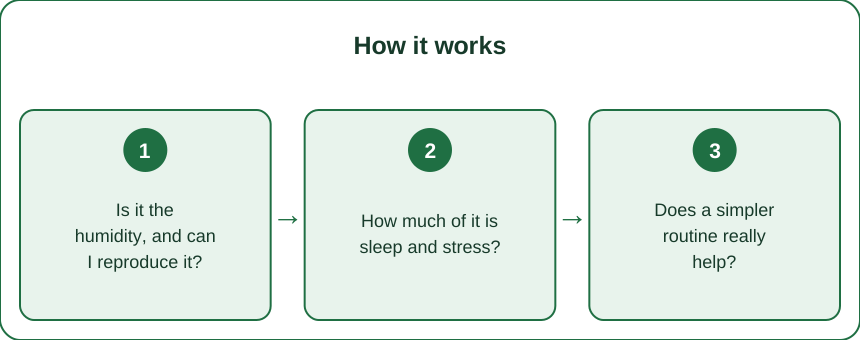
Is it the humidity, and can I reproduce it?
Ambient humidity is probably the largest single factor. The stratum corneum takes moisture from the air as well as from within, and higher humidity means less transepidermal water loss and a plumper, smoother surface.
After 40 this matters more, not less. Barrier lipid production declines with age and particularly through perimenopause, so the skin holds onto its own water less effectively and depends more on ambient conditions.
The home version is a humidifier in the bedroom, running overnight. Eight hours a night at a reasonable humidity level is the closest available equivalent to a humid climate, and it is noticeable within a week.
The timing matters seasonally. The worst period for indoor humidity is the first weeks the heating comes on, which dries indoor air sharply. This is exactly when people conclude their routine has stopped working.
Layering a humectant under an occlusive reproduces part of it too. Hyaluronic acid or glycerin on damp skin, sealed with a moisturiser, imitates the effect of humid air by holding water where it is.
Do not apply a humectant to dry skin in dry air, which can draw water from deeper layers outward and leave skin feeling tighter. Damp skin, then seal.
How much of it is sleep and stress?
A holiday typically adds one to two hours of sleep a night, and skin repair processes are concentrated during sleep. Barrier recovery, cell turnover, and inflammation resolution all improve with more of it.
Cortisol is the mechanism that connects stress to visible skin. Sustained elevation impairs barrier recovery, increases inflammation, and is associated with more reactive, duller-looking skin.
After 40 this coupling gets stronger. Slower barrier repair means the skin spends longer in the compromised state after any stressor, so the same stress produces a more visible result than it did at 30.
The visible signs are specific: under-eye shadowing, a duller and less even tone, more reactivity to products that were previously fine, and slower healing of blemishes.
Which is why the improvement shows on about day three of a holiday, not day one. It is a recovery curve, not an environment switch.
The home version is unglamorous: protecting sleep is the highest-return skincare intervention available after 40, and it costs nothing. An extra 45 minutes a night for a fortnight does more visibly than most new products.
Does a simpler routine really help?
Most people take fewer actives on holiday, typically dropping retinoids and exfoliating acids and using a basic cleanser, moisturiser, and sunscreen.
Low-grade over-exfoliation is extremely common and largely invisible to the person doing it. It shows as dullness, tightness, and reactivity rather than obvious irritation, which is why it goes unrecognised for months.
After 40 the tolerance for actives changes, often downward, and a routine that worked at 35 can be too much at 45 without anything else having changed.
The diagnostic is simple: if your skin looks better after a week of doing almost nothing, the routine was doing net harm, not net good.
The home version is a deliberate two-week simplification. Cleanser, moisturiser, sunscreen. Then reintroduce one active at a time, at reduced frequency, and see what your skin actually tolerates now.
Reintroduce retinoids at half the previous frequency, because the barrier will have improved and the temptation is to resume at the old cadence immediately.
And separate actives rather than layering them. Acids one night, retinoid another, is far better tolerated after 40 than a stacked routine, and it is often the entire difference.
Myth vs Fact: Holiday Skin After 40
Myth: It is the sea air. Fact: it is humidity, sleep, and lower stress. A humid inland destination produces a similar effect, and a dry coastal one does not.
Myth: A tan is making your skin look healthier. Fact: a tan is a visible injury response, and it evens out tone temporarily while accelerating exactly the changes you are trying to prevent. This is the one holiday variable not worth reproducing.
Myth: Your expensive routine stopped working. Fact: if a week of doing nothing improved things, the routine was contributing to the problem. That is a dosing issue, not a product failure.
Myth: You need to drink litres of water for it to matter. Fact: hydration matters but the effect is modest compared with ambient humidity and barrier function. Being genuinely dehydrated shows; drinking above adequate does little extra.
Myth: The improvement is just being relaxed and looking at yourself in better light. Fact: light and mood are genuinely part of it, but barrier recovery, sleep-driven repair, and reduced cortisol are measurable mechanisms with real effects.
Myth: It fades because home water is harder. Fact: hard water can contribute to tightness and irritation, but it is a smaller factor than heating-dried air, resumed actives, and lost sleep - which all restart the same week.
FAQ: Holiday Skin and Home Skin After 40, Answered
Why does my skin look better on holiday?
Higher humidity, more sleep, lower cortisol, more consistent hydration, and a simplified routine with fewer actives. After 40 the barrier is slower to recover, so it responds visibly to all five.
Can I reproduce it at home?
Four of the five. A bedroom humidifier, protected sleep, a two-week routine simplification, and consistent hydration. The sun exposure is the one variable you should not reproduce.
Why does it disappear within a week of getting back?
Everything reverses at once - drier indoor air, less sleep, resumed actives, and normal stress. The barrier improvement built over a week unwinds quickly because recovery capacity is slower after 40.
How do I know if my routine is over-exfoliating me?
If a week of cleanser, moisturiser, and sunscreen improves your skin, the routine was doing net harm. Low-grade over-exfoliation presents as dullness, tightness, and reactivity rather than obvious irritation.
How should I reintroduce actives after a simplification?
One at a time, at roughly half the previous frequency, on separate nights rather than layered. Acids one night and a retinoid another is far better tolerated after 40 than stacking them.
Is the tan part of why it looks good?
Partly, and it is the part not worth keeping. A tan is a visible injury response that temporarily evens tone while accelerating the changes you are working against. This is general information, not medical advice.
TL;DR:
- Humidity, sleep, lower cortisol, hydration, and a simplified routine explain holiday skin - not sea air.
- After 40 the barrier repairs more slowly, so every one of those variables shows more visibly than it did at 30.
- A bedroom humidifier is the closest reproducible version, and it matters most the week the heating comes on.
- If a week of doing almost nothing improved your skin, the routine was over-exfoliating you.
- Reintroduce actives one at a time at half the frequency, on separate nights rather than stacked.
Four of the five holiday variables are free. The fifth is the one you should leave behind.
Keep Reading
This article is for general informational and styling purposes only. Fit, sizing, and product availability may vary.