Vitamin C Serum After 40: Your Questions, Answered
Quick Answer: Vitamin C is one of the few actives with genuinely strong evidence behind it, and it becomes more useful after 40, not less - it supports collagen synthesis, brightens the pigmentation that becomes more visible in this decade, and provides antioxidant protection alongside sunscreen. But the standard advice needs adjusting: L-ascorbic acid at 15-20% is the best-studied form and the most irritating, and skin that is drier and more reactive in your forties often does better on 10-15%, or on a gentler derivative. Morning use, under sunscreen, is where it earns its place.
Below, the questions that actually come up - starting with the ones that decide whether you should bother at all.
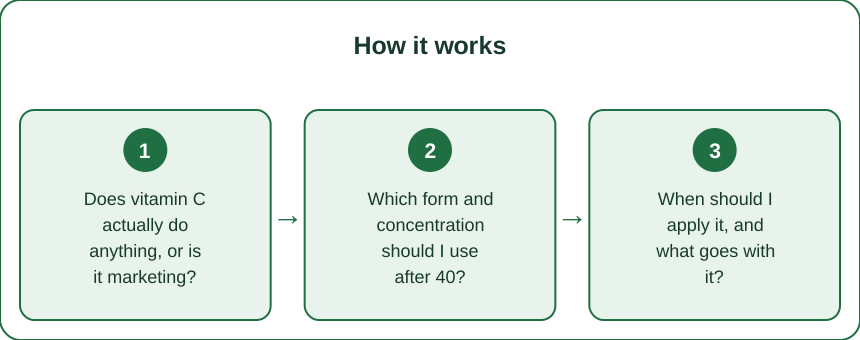
Does vitamin C actually do anything, or is it marketing?
It does, and it is one of the more solidly supported actives on the shelf.
What is the evidence for?
Three things specifically. Collagen synthesis - vitamin C is a required cofactor for the enzymes that build collagen, which is not a marketing claim but basic biochemistry. Pigmentation - it inhibits tyrosinase, the enzyme in melanin production, which is why it works on the dark spots that surface in your forties. Antioxidant protection - it neutralises free radicals generated by UV and pollution, which is why it works alongside sunscreen rather than instead of it.
How much difference will I actually see?
On pigmentation, visible improvement in 8-12 weeks with consistent use. On overall brightness and tone, often sooner - around 4-6 weeks. On fine lines, subtle and slow, and you should not buy it primarily for that.
Is it worth the money?
A well-formulated vitamin C is one of the better value actives per unit of visible result, behind only sunscreen and retinoids. An expensive one is not automatically better - formulation stability matters far more than price, and several mid-price options outperform luxury ones.
Which form and concentration should I use after 40?
This is where most people get it wrong, in both directions.
Is L-ascorbic acid always the best choice?
It is the best-studied and most potent form, and it is also the most irritating and least stable. For skin in your forties that is drier and more reactive than it was, that trade-off is not automatic. L-ascorbic acid at 10-15% delivers most of the benefit with substantially less irritation than 20%.
What about the derivatives?
Sodium ascorbyl phosphate, magnesium ascorbyl phosphate, and ethylated ascorbic acid are more stable, less irritating, and require conversion in the skin - so they are gentler and somewhat less potent. For sensitive or rosacea-prone skin, or if you are also using a retinoid, a derivative is often the better real-world choice because the product you use daily beats the stronger product you use twice a week.
Does the pH matter?
For L-ascorbic acid, yes - it needs a pH below 3.5 to penetrate, which is exactly why it stings. Derivatives work at skin-friendly pH, which is most of why they are gentler.
What about vitamin C plus vitamin E and ferulic acid?
This combination is well supported - vitamin E and ferulic acid stabilise the vitamin C and extend its antioxidant activity. If a product has all three, that is a genuine formulation advantage rather than a marketing flourish.
When should I apply it, and what goes with it?
Order and timing matter more with vitamin C than with most products.
Morning or night?
Morning. The antioxidant protection works alongside sunscreen against daytime UV and pollution exposure. Night is when you want your retinoid.
Where in the routine?
On clean skin, before anything heavier. Cleanse, vitamin C, wait 60 seconds, moisturiser, sunscreen. The wait is not fussiness - applying moisturiser onto wet serum dilutes it.
Can I use it with retinol?
Yes, but separate them by time of day - vitamin C in the morning, retinoid at night. Using both at once is a common cause of the irritation that makes people abandon both. This matters more after 40 because the skin barrier is already less resilient.
Can I use it with niacinamide?
Yes. The old advice that they cancel each other out came from lab conditions that do not apply to formulated products on skin. Use them together freely - in fact, niacinamide can reduce the irritation from vitamin C.
What about exfoliating acids?
Alternate rather than stack. Vitamin C in the morning and your AHA at night, on different nights from your retinoid. Stacking three low-pH actives is the fastest route to a damaged barrier, and a damaged barrier in your forties takes considerably longer to repair than it did at 25.

Why did my vitamin C stop working or start stinging?
Usually one of four things, and three are fixable.
Has it oxidised?
Most likely. L-ascorbic acid oxidises on exposure to air, light, and heat, turning yellow then orange then brown. A brown serum is not just less effective, it can be irritating. If yours has changed colour, replace it - and store the next one away from the shower steam.
How long does an open bottle last?
Roughly three months for L-ascorbic acid in a dropper bottle, less if it is stored badly. Airless pumps and opaque packaging extend this considerably. Buy smaller bottles rather than value sizes.
Why does it sting now when it did not before?
Usually a barrier problem rather than a product problem. If your skin has been dry, over-exfoliated, or recently retinoid-heavy, the same product will suddenly sting. Stop for a week, repair the barrier, restart at a lower frequency.
Could it be the season?
Yes, and this is a genuinely common one right now. As the weather turns and indoor heating starts, skin gets drier and its tolerance for low-pH actives drops. A concentration that was comfortable in July can be too much in October. Adjusting downward as the season changes is normal, not a failure.
Does anything change specifically because I am over 40?
Several things, and they change the practical advice rather than the principle.
Is my skin less able to tolerate it?
Often, yes. The barrier is thinner and produces less oil, and in perimenopause the drop in oestrogen accelerates both. The same 20% serum you used comfortably at 35 may not suit you now. This is a reason to lower the concentration, not to stop.
Does it work as well on older skin?
The collagen effect is if anything more relevant, because synthesis has slowed. The pigmentation effect is more visible, because accumulated sun exposure is what surfaces as dark spots in this decade.
Should I use more of it?
No. Four to five drops covers the face and neck and more does not do more - it just oxidises on the surface. Extend it to the neck and chest, which are usually more sun-damaged and consistently neglected.
Is it enough on its own for dark spots?
Rarely. It works best combined with daily sunscreen, which is the actual determinant, plus a retinoid at night. Vitamin C alone against ongoing unprotected sun exposure is a losing position.
When should I see a professional?
If pigmentation is new, changing, asymmetric, or a single spot behaving differently from the others, get it looked at rather than treated with serum. Likewise if you have persistent redness or burning. This is general information, not medical advice.
FAQ: Vitamin C, Answered Quickly
Can I use it on my eye area?
Most formulations are too low-pH for the eyelid. Use it up to the orbital bone, or choose an eye product with a derivative form.
Does it make me more sun sensitive?
No - the opposite. It supports your sunscreen’s performance. It does not replace sunscreen, and it is not an SPF.
Fridge or bathroom cabinet?
Fridge is better for L-ascorbic acid, and genuinely extends its life. Away from the shower either way - heat and steam are what kill it.
Powder forms you mix yourself?
They solve the stability problem completely and are worth considering if you keep losing serums to oxidation. Mixing consistency is the trade-off.
Does a vitamin C moisturiser count?
Less effective than a serum, because concentration is typically lower and the delivery is worse. Fine as an extra, not as the main event.
How long before I judge whether it is working?
Twelve weeks of consistent daily use, with sunscreen. Anything shorter and you are judging on brightness alone, which is the fastest and least meaningful effect.
TL;DR:
- Vitamin C is genuinely evidence-backed for collagen support, pigmentation, and antioxidant protection, and it matters more after 40, not less.
- L-ascorbic acid at 10-15% beats 20% for most forties skin - the gentler version you use daily wins.
- Morning, on clean skin, before moisturiser and sunscreen. Retinoid at night, separately.
- Niacinamide is fine alongside. Stacking multiple low-pH actives is not.
- A brown or orange serum has oxidised - replace it. Buy small bottles, store cool and dark.
- Give it twelve weeks and pair it with daily sunscreen, or you are working against yourself.
The honest summary: it is not the most powerful thing on your shelf - sunscreen and a retinoid are - but it is the one that most reliably makes skin look brighter and more even in the decade where those two things start to slip.
Keep Reading
This article is for general informational and styling purposes only. Fit, sizing, and product availability may vary.