What Happens to Your Skin in the Last Weeks of Summer After 40
Quick Answer: Late August skin over 40 is dealing with accumulated sun exposure that only becomes visible now - pigment produced in June and July surfaces on a delay of several weeks. At the same time, humidity is starting to fall, which strips a barrier already compromised by a summer of sun, chlorine, salt and heat. The result is the specific combination people notice at the end of August: more visible unevenness, more texture, and skin that feels tight despite the same routine. Most of it responds well to barrier repair now and a slow, measured reintroduction of actives - not to an aggressive correction campaign.
You look in the mirror at the end of August and something has shifted. The freckles have merged. There is a patch on one cheek that was not there in June. The skin feels tight in the morning in a way it did not last month, and the routine has not changed at all.
This is the most predictable skin moment of the year after 40, and understanding the sequence makes the response much simpler.

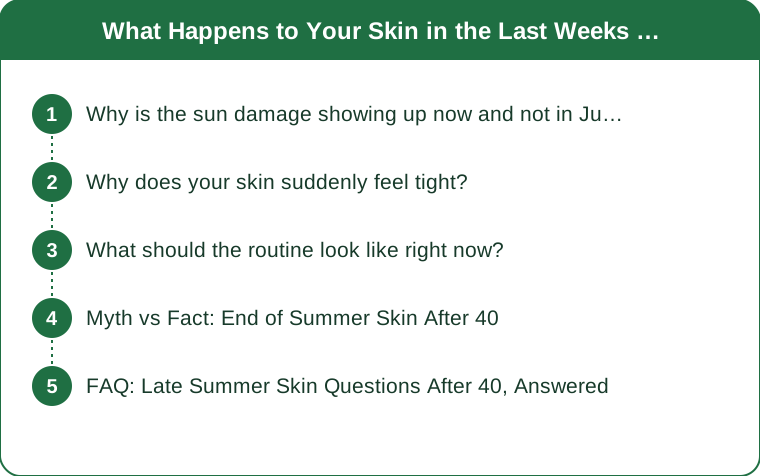
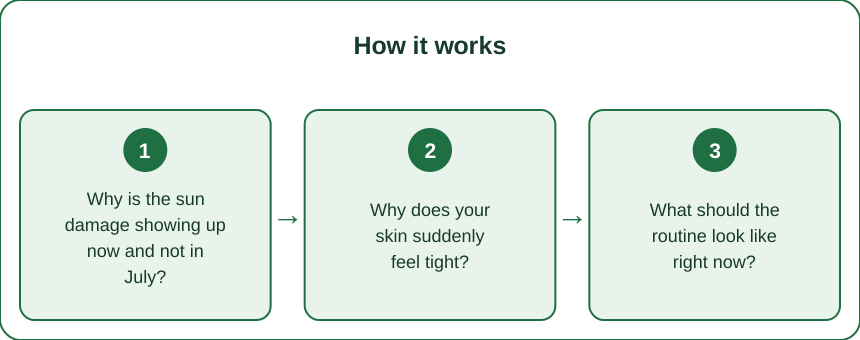
Why is the sun damage showing up now and not in July?
Because pigment formation runs on a delay, and the delay lengthens with age.
UV exposure triggers melanocytes to produce melanin, but the visible result at the skin surface takes time to appear - and the full expression of a summer’s exposure typically surfaces weeks after the exposure itself. What you are looking at in late August is largely June and July.
After 40, two things make this more visible. Melanocyte distribution becomes less even with age, so the same trigger produces patchier results rather than an even tan. And cell turnover slows, so pigment that has surfaced clears more slowly than it did at 30.
This is why the classic late-August observation is not I got darker but my skin got less even. The unevenness is the age-related part.
There is also a hormonal overlay that matters for a lot of women in this decade. Melasma is heat and hormone sensitive, not only UV sensitive - which is why it worsens over a summer even in people who were careful with sunscreen, and why it responds poorly to treatments aimed only at sun exposure. If the pattern is symmetrical across both cheeks, the upper lip or the forehead, that is the likely story, and it is worth a professional opinion rather than a stronger product.
Why does your skin suddenly feel tight?
Because ambient humidity is falling and your barrier has had a hard summer.
The skin barrier holds water using lipids and natural moisturizing factors, and a summer of UV, chlorine, salt water, heat and air conditioning depletes both. Through July the ambient humidity is high enough to mask the deficit - there is enough water in the air that a compromised barrier still feels fine.
Late August is when outdoor dew points start to drop in most of the country, and indoor air starts drying out as cooling systems run in cooler conditions. The barrier deficit stops being masked and starts being felt.
After 40, this hits harder because barrier lipid production and natural moisturizing factor levels are already lower than they were a decade earlier, and estrogen decline in the perimenopausal years reduces both further along with skin hydration and elasticity.
The specific signs to look for: tightness within a minute of washing, products that used to absorb now sitting on the surface, mild stinging from things that never stung, and increased flaking around the nose and mouth.
Those are barrier signs, not dryness signs, and they call for a different response - repair the barrier before adding anything corrective. Layering an exfoliating acid onto a compromised barrier in late August is how a mild issue becomes an eight-week problem.

What should the routine look like right now?
Repair first, correct second, and give it three to four weeks.
Weeks one and two - repair only. Drop actives back to a minimum. Cleanse with something non-stripping, and use a moisturizer with ceramides, cholesterol and fatty acids - the three lipids the barrier is actually built from. Add a humectant layer underneath if the air is dry: glycerin or hyaluronic acid applied to damp skin, then sealed with the moisturizer. Applied to dry skin in dry air, a humectant can make tightness worse rather than better.
Keep sunscreen daily. Late August UV is still substantial, and pigment that is actively resolving re-darkens fast with any exposure.
Weeks three and four - reintroduce, one thing at a time. If you used a retinoid before summer, restart at a lower frequency than you finished at - twice a week, not every other night - and expect to need four to six weeks to get back to where you were. Do not restart a retinoid and an acid in the same week.
For pigment specifically, the evidence-supported ingredients are tranexamic acid, azelaic acid, niacinamide, vitamin C and alpha arbutin. All of them work slowly and all of them are undone by sun exposure. Expect twelve weeks, not three, and pick one or two rather than five.
This is general information, not medical advice. Any pigmented spot that is new, changing, asymmetric, or has an irregular border should be looked at by a dermatologist rather than treated with skincare.
Myth vs Fact: End of Summer Skin After 40
Myth: A strong exfoliation will clear the summer damage fastest. Fact: Aggressive exfoliation on a barrier-compromised, recently sun-exposed face is the most reliable way to trigger post-inflammatory hyperpigmentation - which is more pigment, not less. After 40 the inflammatory response is slower to resolve, so the risk period is longer. Repair, then correct.
Myth: The tan is protecting me, so I can ease off sunscreen in September. Fact: A tan provides a very small protective factor - far below any usable sunscreen - and UVA levels stay high well into autumn. UVA is the wavelength most associated with pigment and with photoaging, and it is far less seasonal than UVB.
Myth: If it did not burn, it did not damage. Fact: Pigment change, collagen degradation and barrier disruption all occur below the burn threshold. Most of what shows up in late August came from days that felt uneventful.
Myth: Melasma and sun spots are treated the same way. Fact: They are not. Melasma is heat and hormone reactive and frequently worsens with treatments that work on sun spots, including some laser approaches. The symmetrical pattern is the tell, and it justifies a professional consultation.
FAQ: Late Summer Skin Questions After 40, Answered
How long until my skin looks even again?
Pigment surfacing now generally takes several months to fade on its own, and the process is slower after 40 because turnover has slowed. With consistent sun protection and a targeted ingredient, twelve weeks is a realistic expectation for meaningful improvement. Without sun protection, no ingredient will get there.
Should I stop my retinoid in late summer?
Not necessarily, but reduce frequency if the barrier is showing signs of strain - tightness, stinging, flaking. A retinoid on a compromised barrier is a common cause of the irritation people blame on the weather. Reduce, repair, then rebuild frequency slowly.
Why is my skin oily and tight at the same time?
This is the classic barrier signature, not a contradiction. A compromised barrier loses water rapidly, and skin frequently responds to that water loss by increasing oil production. Treating it as oily skin with stripping cleansers makes both halves worse. Restoring the lipid barrier usually settles the oil within a few weeks.
TL;DR:
- Late August pigment is June and July surfacing on a delay that lengthens with age.
- Uneven rather than darker is the over-40 signature, driven by patchier melanocyte distribution and slower turnover.
- Falling humidity unmasks a summer-depleted barrier - tightness, stinging and flaking are barrier signs, not dryness.
- Repair for two weeks before correcting anything. Ceramides, cholesterol and fatty acids, plus humectants on damp skin.
- Reintroduce actives one at a time, at lower frequency than you stopped at.
- Symmetrical patterning suggests melasma, which is treated differently and deserves a professional opinion.
The end of August is not a skin failure. It is the summer arriving on schedule, several weeks late.
Keep Reading
This article is for general informational and styling purposes only. Fit, sizing, and product availability may vary.