How Should Your Skincare Change When Summer Turns to Autumn After 40
Quick Answer: Three things change at once in early autumn: ambient humidity falls, indoor heating begins drying the air further, and the skin barrier - which is already slower to repair itself after 40 - loses water faster than it can replace it. The fix is to increase occlusive moisture rather than adding more active ingredients, reduce exfoliation frequency temporarily, and keep sunscreen exactly where it was. Most autumn skin complaints are barrier problems misdiagnosed as ageing.
The routine that felt perfect in July is now leaving your skin tight by mid-morning, makeup is clinging to patches that were not there a month ago, and the obvious conclusion is that something has changed about your skin. Something has - but it is the air, and the response is different from what most people reach for.

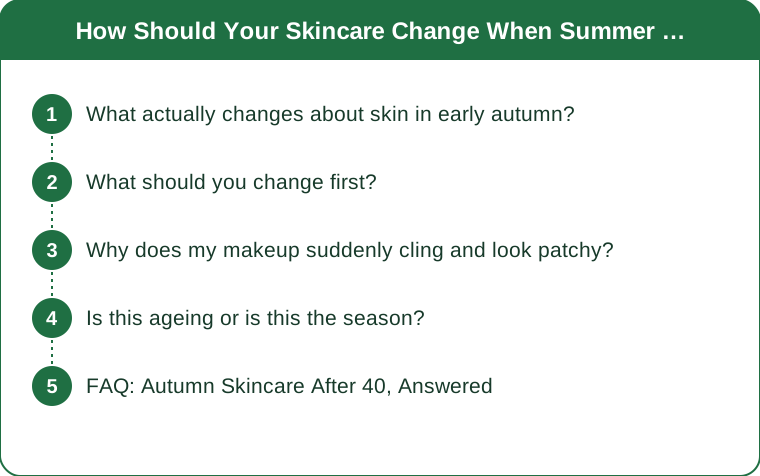
What actually changes about skin in early autumn?
Four things, and they compound rather than simply adding up.
Ambient humidity drops. Skin’s outermost layer holds water partly by drawing it from the surrounding air. When outdoor humidity falls, the gradient reverses and water leaves the skin faster - a process called transepidermal water loss.
Indoor heating makes it substantially worse. Heated indoor air can be considerably drier than outdoor air, and most people spend the great majority of autumn and winter hours in it. The heating switch-on date is a more reliable predictor of autumn skin complaints than the first cold day.
Barrier repair is slower after 40. Skin’s natural production of lipids and its rate of cell turnover both decline with age, and oestrogen decline around perimenopause is associated with reduced skin hydration and thickness. That means the same environmental challenge produces a bigger effect than it did a decade ago and takes longer to recover from.
And the summer routine was built for the opposite problem. Lightweight gel moisturisers, higher exfoliation frequency, and oil-controlling products all made sense in humid heat. Running them into a dry season is like keeping the air conditioning on in October.
The result is a specific pattern: tightness within an hour or two of cleansing, flaking around the nose and on the cheeks, makeup clinging or looking patchy, and often a paradoxical increase in oiliness in some areas as skin over-compensates. Fine lines look more prominent - not because they deepened in three weeks, but because dehydrated skin sits differently over them.
Worth separating clearly: dryness is a lack of oil, dehydration is a lack of water, and most autumn complaints are dehydration. They need different responses, and reaching for a heavy oil when the problem is water loss is a common mismatch.
What should you change first?
In order, because doing all of it at once makes it impossible to tell what worked.
First: change the moisturiser, not the actives. A richer moisturiser with occlusive ingredients - the ones that physically slow water loss rather than adding water - is the single highest-impact change. Look for formulations containing ceramides, which are part of skin’s own barrier lipids, alongside humectants such as glycerin or hyaluronic acid to draw water in, and an occlusive layer to keep it there.
Second: apply moisturiser to damp skin. Applying within about a minute of cleansing, while skin is still slightly wet, traps significantly more water than applying to fully dry skin. This costs nothing and it is the most commonly skipped step.
Third: reduce exfoliation temporarily. If you were exfoliating three times a week in summer, drop to once or twice while the transition settles. Over-exfoliation and seasonal dryness produce nearly identical symptoms, which is why so many people respond to autumn flaking by exfoliating more and make it considerably worse.
Fourth: change the cleanser before you change anything else active. A foaming cleanser that felt refreshing in August can be stripping in October. A cream or milk cleanser, or simply cleansing thoroughly only at night and rinsing with water in the morning, resolves a lot of morning tightness on its own.
Fifth: do not stop the sunscreen. UVA, which is associated with photoageing, penetrates cloud and glass and is present year round. Autumn sun feels gentler because UVB - the burning wavelength - is lower, and that is precisely why people stop. Daily broad-spectrum protection is the highest-value anti-ageing step available and it is season-independent.
Sixth, and only after the above have settled: adjust retinoids carefully. If you use a retinoid, dry weather often increases irritation. Reducing frequency for two or three weeks, or buffering by applying moisturiser first, usually resolves it - and is far better than stopping altogether and losing months of adaptation.
And the environmental change worth more than any product: a humidifier in the bedroom. Eight hours a night in air that is not aggressively dry does more for barrier recovery than most upgrades to a routine.

Why does my makeup suddenly cling and look patchy?
Because makeup sits on the skin’s surface, and the surface changed.
Dehydrated skin has a rougher microtexture. Cells that are not fully hydrated do not lie as flat, so foundation catches on the raised edges rather than settling smoothly. This is why the effect appears strongest on cheeks and around the nose, where flaking starts.
Product mismatch is the second cause. A summer-weight foundation formulated to resist humidity and oil often contains ingredients that behave badly over dry skin, gripping unevenly and emphasising texture rather than blurring it.
And timing matters more than people think. Applying makeup immediately after moisturiser, before it has absorbed, causes the two to mix and pill. Waiting three to five minutes after moisturiser - and after sunscreen - makes a visible difference to how foundation sits.
The sequence that works in dry conditions: hydrating layer on damp skin, richer moisturiser, sunscreen, then a genuine pause, then makeup. If flaking is already present, a gentle exfoliation once - not repeatedly - clears the loose surface, and then the focus goes entirely to preventing it recurring.
A hydrating primer helps more than a mattifying one now, which is the opposite of what worked in July. And cream formulations generally sit better than powder ones over dehydrated skin, because powder settles into texture rather than covering it.
Consider setting spray as a hydration step rather than a finishing one. Used before foundation as well as after, a hydrating mist can improve how the whole face sits.
One thing to check that is easy to miss: how hot your shower is. Very hot water strips surface lipids efficiently, and a hot morning shower followed by immediate makeup application is a reliable recipe for a patchy face by ten o’clock.
Is this ageing or is this the season?
A fair question, and there are ways to tell.
Seasonal dehydration appears quickly - over days or two or three weeks - and it tracks the weather and the heating. Age-related change is gradual over months and years and does not improve when you turn a humidifier on.
Seasonal change is largely reversible. If richer moisture, reduced exfoliation, and a gentler cleanser produce clear improvement within two to three weeks, the problem was environmental. That is genuinely good news and it is the most common answer.
Fine lines that look worse in autumn are usually looking worse rather than being worse. Dehydrated skin sits differently and reflects light differently, which exaggerates existing lines. Rehydrate and they look as they did in August.
Some things are genuinely age-related and worth addressing directly rather than seasonally: loss of firmness, changes in pigmentation, and reduced skin thickness. These respond to consistent long-term use of evidence-backed actives - retinoids, sunscreen, and vitamin C among them - rather than to seasonal adjustment.
And some things warrant professional advice rather than product changes. Persistent redness, new or changing moles, skin that does not improve with basic barrier repair over a month, sudden severe dryness, or any new persistent itch are worth showing to a doctor or dermatologist. Perimenopausal skin change can also be discussed with a GP, particularly where it accompanies other symptoms.
The practical takeaway: treat the season first, because it is fast, cheap, and reversible, and only conclude that something is age-related after the environmental explanation has been ruled out. Most people get it backwards, buy an expensive serum in October, and credit it with an improvement that a moisturiser and a humidifier would have delivered.
This is general information, not medical advice.
FAQ: Autumn Skincare After 40, Answered
Why does my skin get dry as soon as autumn starts?
Ambient humidity falls and indoor heating dries the air further, so water leaves the skin faster than it is replaced. After 40, skin produces fewer barrier lipids and repairs more slowly, so the same drop in humidity produces a larger effect than it used to and takes longer to recover from.
Should I change my whole skincare routine for autumn?
No - change the moisturiser first and leave everything else alone for two or three weeks. A richer formulation with ceramides and humectants, applied to damp skin, addresses most seasonal complaints. Changing several things at once makes it impossible to know what helped.
Do I still need sunscreen in autumn and winter?
Yes. UVA, the wavelength most associated with photoageing, is present year round and penetrates cloud and window glass. Autumn feels gentler because burning UVB is lower, which is exactly why people stop - and why the photoageing continues quietly.
Should I exfoliate more if my skin is flaking?
Usually the opposite. Seasonal dehydration and over-exfoliation produce very similar flaking, and increasing exfoliation in response to seasonal dryness reliably makes it worse. Reduce frequency, focus on barrier repair, and reintroduce exfoliation gradually once the flaking stops.
Is my skin changing because of perimenopause or because of the weather?
Seasonal change appears within days or weeks, tracks the heating and the weather, and reverses with better moisture. Hormone-related change is gradual over months, involves firmness and thickness rather than surface dryness alone, and does not resolve with a humidifier. Treat the seasonal explanation first, and raise the rest with a GP if it persists.
TL;DR:
- Autumn skin complaints are usually barrier dehydration, not ageing - humidity drops and heating finishes the job.
- Change the moisturiser first, apply it to damp skin, and leave everything else alone for two weeks.
- Reduce exfoliation rather than increasing it; flaking and over-exfoliation look identical.
- Keep sunscreen exactly as it was - UVA does not take the season off.
- A bedroom humidifier outperforms most product upgrades for barrier recovery.
If it improved within three weeks of a richer moisturiser, it was the weather. That is the cheapest good news in skincare.
Keep Reading
This article is for general informational and styling purposes only. Fit, sizing, and product availability may vary.