Niacinamide After 40: The Questions Everyone Actually Asks
Quick Answer: Niacinamide is one of the better-supported ingredients for skin in the forties because it targets three things that all shift at once: barrier lipid production, pigmentation, and inflammation. Concentrations of 2 to 5 percent handle most of that; 10 percent is not proportionally better and causes flushing in a meaningful number of people. It layers well with almost everything, including retinol.
If your routine feels like it stopped working, niacinamide is one of the few additions that helps the underlying reason rather than the symptom.
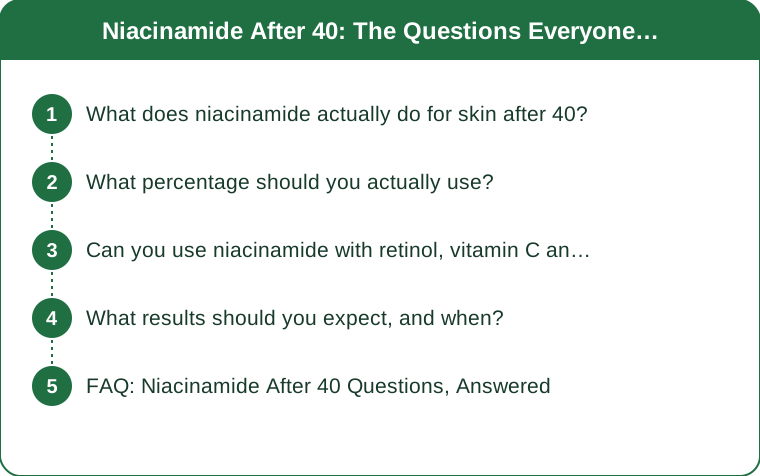
What does niacinamide actually do for skin after 40?
Three mechanisms, all relevant to what changes in this decade.
It supports ceramide production. Niacinamide increases the synthesis of ceramides and free fatty acids in the stratum corneum. This matters because barrier lipid production declines with age and drops further around perimenopause as estrogen falls — and a weaker barrier is the reason products that never stung before start stinging.
It interrupts pigment transfer. Melanin is produced in melanocytes and transferred to surrounding skin cells. Niacinamide interferes with that transfer step, which is why it works on the diffuse dullness and uneven tone that follows years of sun exposure rather than only on discrete dark spots.
It reduces inflammation. This is the quiet one. Low-grade chronic inflammation contributes both to pigmentation and to collagen breakdown, and niacinamide has measurable anti-inflammatory activity — which is also why it helps rosacea-prone and reactive skin.
What it does not do: it is not a retinoid. It does not drive cell turnover, and it will not do what tretinoin does for fine lines. It also does not replace sunscreen. Think of it as improving the conditions your other actives work in.
What percentage should you actually use?
Lower than the marketing suggests, and the reason is specific.
2 to 5 percent is where most of the published benefit sits — barrier support, pigmentation, sebum regulation, redness. Studies at 4 to 5 percent show results on tone and barrier function over 8 to 12 weeks.
10 percent does not produce proportionally better results and does produce noticeably more irritation. The characteristic complaint is a hot, flushed feeling within minutes of application, which is a real vascular response rather than an allergy. Skin that is already reactive at 40-plus is more likely to show it.
Above 10 percent has no meaningful evidence advantage and a much higher irritation rate.
The practical approach: if you are already using a moisturizer with 4 percent niacinamide, you have a working dose and adding a 10 percent serum on top adds risk without adding much benefit. Check what you already have — niacinamide is in a very large share of moisturizers, sunscreens and serums, and stacking three products can put you well above what you intended without ever buying a high-percentage product.
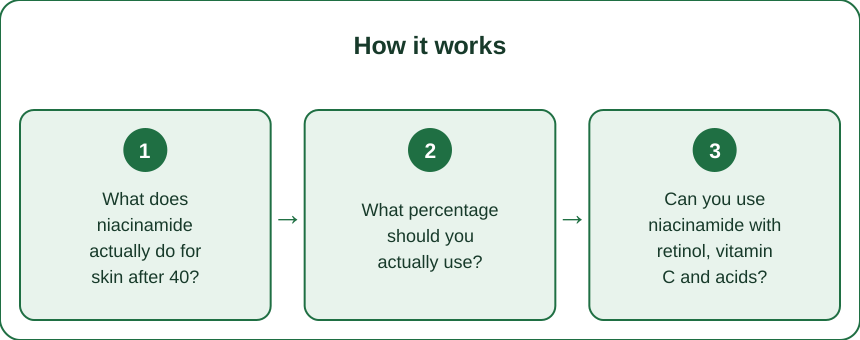
Can you use niacinamide with retinol, vitamin C and acids?
Yes to all three, and the old warnings have mostly been retired.
With retinol: actively good. Niacinamide’s barrier support directly offsets retinoid irritation, and pairing them lets many people tolerate a retinoid they otherwise could not. Apply niacinamide first or use a niacinamide-containing moisturizer as a buffer.
With vitamin C: fine. The old claim was that combining them produces nicotinic acid and causes flushing. That reaction requires heat and conditions not present on your face, and the concern has largely been set aside. If you personally flush, separate them morning and evening — but there is no need to avoid the combination preemptively.
With exfoliating acids: fine, with a caveat. Both are well tolerated together. The caveat is total load — if you are using an acid, a retinoid and a high-percentage niacinamide, the issue is the cumulative demand on a barrier that is already producing fewer lipids than it did a decade ago.
Order: thinnest to thickest. Water-based niacinamide serum goes on after cleansing and before heavier creams. If it is in your moisturizer, that step is already handled.
What results should you expect, and when?
Realistic timelines matter here, because niacinamide is a slow, cumulative ingredient rather than a dramatic one.
2 to 4 weeks: barrier improvements show up first. Less tightness after cleansing, less stinging from other products, less visible flaking. This is the change people notice but do not attribute to niacinamide, because it feels like nothing is happening.
8 to 12 weeks: tone evenness and reduced redness. In studies this is the window where measurable pigmentation changes appear. It is a gradual softening of unevenness, not a spot disappearing.
12 weeks and beyond: texture and pore appearance changes, mostly through sebum regulation and improved barrier function.
What will not happen: deep set lines will not change. Established solar lentigines — the discrete brown spots — respond much less than diffuse unevenness does. Sagging is not addressed at all.
How to actually judge it: photograph in the same light, same time of day, every four weeks. Skin changes are slow enough that daily mirror assessment tells you nothing except how you slept.
FAQ: Niacinamide After 40 Questions, Answered
Can niacinamide cause purging?
No. Purging requires accelerated cell turnover, which niacinamide does not drive. If you break out after starting a niacinamide product, look at the other ingredients in that formula — silicones, oils or a heavier base are more likely culprits than the niacinamide itself.
Morning or night?
Either, and both is fine. It is not photosensitizing, and there is some argument for morning use given its anti-inflammatory activity, but consistency matters far more than timing.
Does it help with perimenopausal skin changes specifically?
It addresses one part of them well — the barrier lipid decline that accompanies falling estrogen — and one part partially, the pigmentation shifts. It does nothing for the collagen loss, which is where retinoids and sun protection carry the load. It is a good supporting ingredient in a perimenopausal routine, not the centerpiece.
Is the flushing dangerous?
No, but it is a signal to lower the concentration. It reflects a vascular response to high-dose topical niacinamide. Drop to 4 or 5 percent and it typically resolves entirely.
TL;DR:
- Niacinamide supports ceramide production, interrupts pigment transfer and reduces inflammation — three things that shift after 40.
- 2 to 5 percent captures most of the benefit; 10 percent adds flushing more than results.
- Check what you already own; it stacks invisibly across moisturizer, serum and sunscreen.
- It layers fine with retinol, vitamin C and acids — the old warnings have largely been retired.
- Barrier improvements in 2 to 4 weeks, tone changes at 8 to 12, nothing for deep lines or sagging.
It is not the exciting ingredient in the routine. It is the one that makes the exciting ones tolerable, which after 40 is worth more.
Keep Reading
This article is for general informational and styling purposes only. Fit, sizing, and product availability may vary.