Rebuilding a Damaged Skin Barrier During Perimenopause: What Actually Works
Quick Answer: Declining estrogen during perimenopause reduces the skin’s natural ceramide and lipid production, thinning the barrier and making previously-tolerated products (retinol, exfoliating acids) suddenly cause redness or sensitivity. The fix is usually reducing active ingredient frequency and rebuilding ceramide levels before reintroducing actives gradually.
Your retinol worked fine for years and now it leaves your skin red and stinging within a week. Nothing about the product changed — but the barrier underneath it likely has, and treating this as a barrier issue rather than a “my skin just changed randomly” issue is what actually gets you back to comfortable skin.

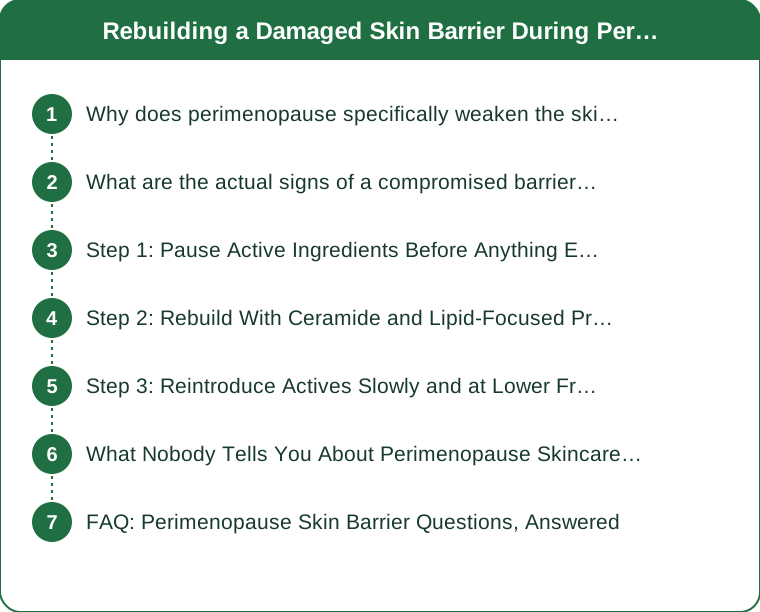
Why does perimenopause specifically weaken the skin barrier?
Estrogen supports ceramide production and collagen density, both critical to a functional skin barrier that retains moisture and resists irritation. As estrogen declines during perimenopause, ceramide levels drop measurably, thinning the barrier’s ability to hold onto water and defend against previously well-tolerated actives.
This is a genuinely physiological shift, not a sign you’re suddenly doing skincare wrong — the same routine that worked at 35 can legitimately stop working at 45-48 purely due to this hormonal change underneath it.
What are the actual signs of a compromised barrier versus normal aging?
Barrier-specific signs include new stinging or redness from previously fine products, visible flaking not explained by dryness alone, a tight feeling even right after moisturizing, and increased reactivity to sun or wind. General aging signs (fine lines, volume loss, texture change) are separate and don’t necessarily indicate barrier damage on their own.
If your skin reacts to things it never used to — not just looks different — that’s the barrier-specific pattern worth addressing directly rather than assuming it’s just “aging skin” broadly.
Step 1: Pause Active Ingredients Before Anything Else
The first move when barrier symptoms appear is pausing retinol, exfoliating acids, and any actively irritating product for 1-2 weeks, not layering on more products to compensate. This feels counterintuitive when your instinct is to “fix” the problem with more skincare, but a compromised barrier needs rest and rebuilding before it can tolerate actives again.
During this pause, stick to a genuinely minimal routine: gentle cleanser, barrier-repair moisturizer, and sunscreen — nothing else.

Step 2: Rebuild With Ceramide and Lipid-Focused Products
Look specifically for moisturizers listing ceramides, cholesterol, and fatty acids together (this specific ratio mimics the skin’s natural barrier lipid composition more effectively than ceramides alone). Niacinamide at moderate concentrations can also support barrier repair without the irritation risk of stronger actives.
Give this rebuilding phase at least 2-4 weeks before judging results — barrier repair happens at the cellular turnover pace of skin, not overnight.
Step 3: Reintroduce Actives Slowly and at Lower Frequency
Once barrier symptoms have calmed, reintroduce retinol or acids at half the previous frequency (twice weekly instead of nightly, for example) and watch for a return of symptoms before increasing further. Many people in perimenopause find their skin permanently tolerates a lower active frequency going forward, not just during a recovery phase.
This is a genuine, lasting shift for many people — accepting a lower maintenance frequency for actives, rather than fighting to return to a pre-perimenopause routine, tends to produce more consistent comfortable skin long-term.
What Nobody Tells You About Perimenopause Skincare Changes
Many dermatologists report this exact pattern — perimenopausal patients arriving confused about why a long-trusted product “suddenly stopped working” — often enough that it’s now a recognized, named phase in skincare guidance rather than an individual anomaly. You are not alone in this, and it’s not a sign your routine or discipline failed.
Also worth knowing: this barrier sensitivity phase is often temporary in intensity, even though some degree of increased sensitivity may persist — many people find their skin partially re-stabilizes at a ‘new normal’ within several months of adjusted care, though it may not fully return to pre-perimenopause tolerance.
FAQ: Perimenopause Skin Barrier Questions, Answered
How long does barrier repair typically take during perimenopause?
Most people see meaningful improvement within 2-4 weeks of a genuinely reduced, ceramide-focused routine, though full comfort with reintroduced actives can take a couple of months.
Should I stop retinol permanently during perimenopause?
Not necessarily — many people successfully continue at a reduced frequency once the barrier has recovered; complete permanent avoidance usually isn’t required.
Is it worth seeing a dermatologist for this specifically?
Yes, if symptoms are severe or don’t improve with a basic barrier-repair routine after several weeks — a dermatologist can rule out other causes and tailor a reintroduction plan. This is general information, not medical advice.
TL;DR:
- Declining estrogen reduces ceramide production, genuinely thinning the skin barrier during perimenopause
- Pause actives first, rebuild with ceramide-focused moisturizers, then reintroduce slowly
- A permanently lower active-ingredient frequency is a common, reasonable long-term adjustment
- See a dermatologist if barrier symptoms are severe or don’t improve within a few weeks. This is general information, not medical advice.
Keep Reading
This article is for general informational and styling purposes only. Fit, sizing, and product availability may vary.