Retinol After 40: Why Your Skin Reacts Differently Than It Did in Your 20s
Quick Answer: Skin over 40 typically has a thinner, slower-renewing outer barrier and less natural oil production, which changes how retinol is tolerated — often meaning more initial dryness and sensitivity, but sometimes better long-term tolerance once the barrier adjusts, since cell turnover was already slowing before you started.
A lot of women assume their retinol tolerance is a fixed trait carried from their 20s. It isn’t — skin barrier function, oil production, and cell turnover rate all shift with age, and retinol interacts with all three.

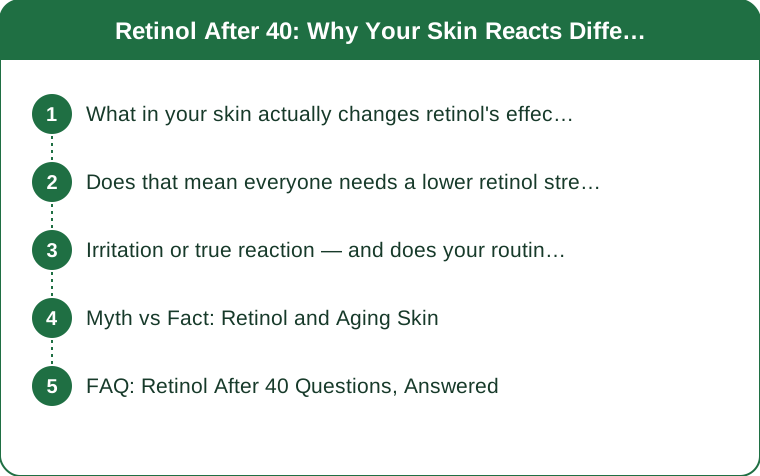
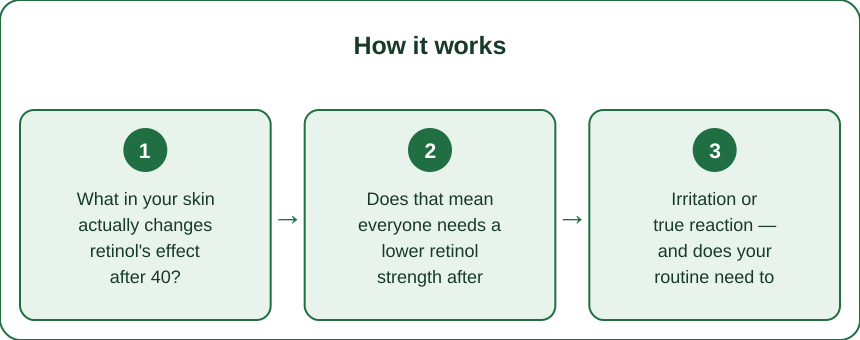
What in your skin actually changes retinol’s effect after 40?
Barrier lipid production declines with age, meaning the skin’s natural oil and ceramide layer that normally buffers active ingredients is thinner than it was at 25. This is the single biggest reason retinol can feel more irritating now even at the same concentration you tolerated before.
At the same time, natural cell turnover slows with age, which is part of why retinol becomes more valuable after 40, not less — it’s compensating for a process your skin used to do more efficiently on its own.
Does that mean everyone needs a lower retinol strength after 40?
Not universally, but it’s the safer starting assumption if you’re new to it or restarting after a break. Starting at a lower percentage (0.025-0.03%) two to three nights a week, then increasing frequency before increasing strength, gives the thinner barrier time to adjust without the flaking and redness that come from going in at full strength.
Some women with well-maintained barriers and years of consistent retinol use tolerate the same or even higher strengths fine after 40 — this is genuinely individual, which is why a slow reintroduction beats assuming either direction.
Irritation or true reaction — and does your routine need to change?
What’s the actual difference between irritation and true retinol reaction?
Mild, temporary flaking and a slight tightness in the first 2-3 weeks is a normal adjustment period at any age. Persistent burning, visible redness lasting more than a day, or a rash-like reaction is a true sensitivity signal to stop and reassess, not push through.
Should I pair retinol with different supporting products after 40?
A richer moisturizer with ceramides and ideally a barrier-supporting routine (avoiding other actives on the same night) matters more now than it might have in your 20s, when the skin’s own barrier did more of that work unassisted.
Myth vs Fact: Retinol and Aging Skin
Myth: If retinol irritated you at 25, it always will. Fact: Tolerance is tied to current barrier condition, hydration habits, and product formulation — not a fixed trait. Many women who couldn’t tolerate it young do fine with a slow reintroduction later.
Myth: Retinol stops being useful once you’re already seeing fine lines. Fact: Retinol’s cell turnover benefit remains relevant at any age showing visible aging signs — it’s not a prevention-only ingredient that loses value once change has started.
Myth: More retinol nights per week always means faster results. Fact: Over-applying past what your barrier can handle causes a cycle of irritation and repair that can actually slow visible improvement compared to a consistent, tolerated frequency.
FAQ: Retinol After 40 Questions, Answered
Can I use retinol with hormonal skin changes from perimenopause?
Generally yes, but hormonal shifts can independently affect skin sensitivity, so introduce it slowly and consider mentioning your full skincare routine at a dermatology visit if you’re navigating both at once.
How long before I’d notice a difference at this age?
Most people need 8-12 weeks of consistent use to see visible texture and tone changes, similar to at younger ages, though initial adjustment (dryness, mild flaking) often resolves within the first 3-4 weeks.
Is prescription-strength retinoid worth considering after 40?
It can be more effective for some concerns, but it also raises irritation risk — this is a reasonable question for a dermatologist rather than a self-directed jump if over-the-counter retinol isn’t cutting it.
TL;DR:
- Thinner barrier lipids and slower natural turnover after 40 change retinol’s tolerance, not its value
- Starting low and slow (0.025-0.03%, 2-3x/week) is the safer default when reintroducing it
- Mild flaking in the first weeks is normal adjustment; persistent redness or burning is a true reaction signal
- Retinol tolerance is about current barrier condition, not a fixed trait from your 20s
This is general information, not medical advice — persistent irritation or specific concerns are worth a dermatologist visit rather than guesswork.
Keep Reading
This article is for general informational and styling purposes only. Fit, sizing, and product availability may vary.