Everything to Know About Starting Retinol After 40
Quick Answer: Starting retinol after 40 works best at a low concentration (0.25-0.5%) two to three nights a week, building up gradually over 6-8 weeks — jumping to daily use or high strength too fast is the main reason people quit from irritation before seeing results.
Skin after 40 responds differently to retinol than skin in your 20s, and most starter guides don’t account for that difference.

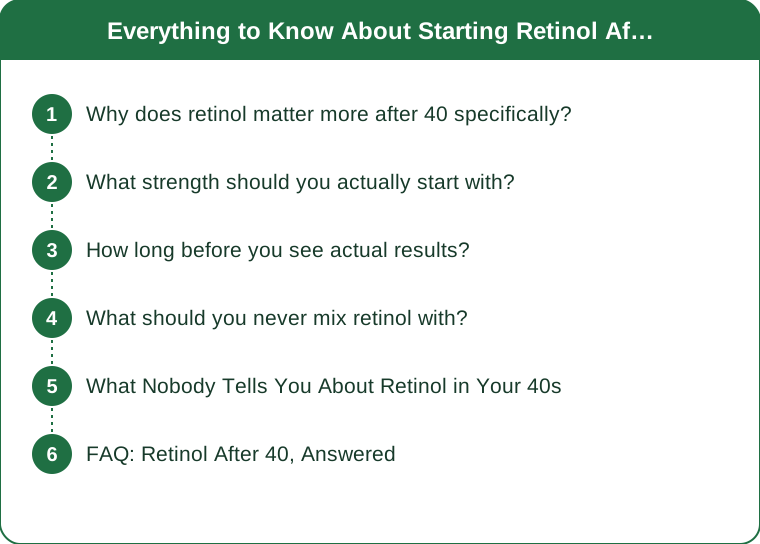
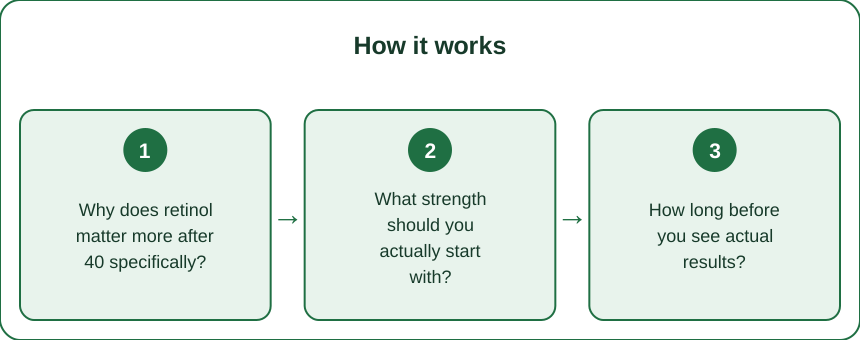
Why does retinol matter more after 40 specifically?
Collagen production declines roughly 1% per year starting in your mid-20s, accelerating around perimenopause, and retinol is one of the few over-the-counter ingredients with strong evidence for stimulating collagen synthesis and increasing cell turnover to offset that decline.
Skin also becomes thinner and slower to renew itself with age, which is exactly the process retinol is designed to support — making the 40s a window where it does more visible work than it did earlier.
What strength should you actually start with?
0.25% to 0.5% retinol, used two to three nights a week, is the right starting point for most people over 40, regardless of prior retinol experience, since mature skin’s barrier tends to be more reactive to irritation than younger skin.
Jumping straight to a 1% strength or daily use is the single most common mistake — it doesn’t speed up results, it just increases the odds of redness and peeling that lead people to quit.
How long before you see actual results?
Visible changes in texture and fine lines typically take 12-16 weeks of consistent use, since retinol works by changing skin cell turnover cycles, which take months, not days, to show up as visible improvement.
The first few weeks often bring purging or mild dryness before things improve — that initial phase is normal adjustment, not a sign the product isn’t working.

What should you never mix retinol with?
Avoid layering retinol with vitamin C, benzoyl peroxide, or strong exfoliating acids (AHA/BHA) on the same night — the combination increases irritation without adding benefit. Most dermatologists recommend alternating: retinol on some nights, brightening or exfoliating actives on others.
Sunscreen the next morning isn’t optional — retinol increases sun sensitivity, and skipping SPF undoes much of the benefit by allowing new UV damage.
What Nobody Tells You About Retinol in Your 40s
Most retinol advice is written for people in their 20s dealing with acne, not people in their 40s dealing with collagen loss and slower cell turnover — and the two situations call for different approaches.
Mature skin often needs more moisture support alongside retinol, not less, since a compromised skin barrier from menopause-related dryness makes irritation more likely than it would be on oilier, younger skin. Sandwiching retinol between two layers of moisturizer (moisturize, apply retinol, moisturize again) is a technique rarely mentioned in general retinol guides but makes a real difference for drier, mature skin.
The other thing nobody mentions: retinol’s effects compound with consistency far more than with strength. A person using 0.25% three nights a week for a year will often see better results than someone cycling on and off a 1% product, because consistency lets the skin’s cell turnover cycle stay on a steady rhythm.
FAQ: Retinol After 40, Answered
Can retinol help with hormonal skin changes from perimenopause?
It can help with the textural and fine-line effects of collagen loss that often coincide with perimenopause, though it doesn’t address hormonal breakouts directly — that’s a separate skin concern.
Is prescription tretinoin better than over-the-counter retinol after 40?
Tretinoin works faster and stronger, but for a first-time user over 40, over-the-counter retinol is the gentler, more sustainable starting point — a dermatologist can guide the step up later if needed.
Do you need to stop retinol eventually?
No — unlike some skincare trends, retinol is typically used long-term. Many dermatologists consider it a maintenance ingredient once your skin is acclimated, not a short course.
TL;DR:
- Start at 0.25-0.5% strength, 2-3 nights a week, and build up slowly over 6-8 weeks
- Expect visible results at 12-16 weeks, not sooner
- Don’t layer retinol with vitamin C or exfoliating acids on the same night
- Consistency at a lower strength beats cycling on and off a stronger one
If you’re starting fresh, pick two nights this week and commit to just those — the routine matters more than the percentage on the bottle.
Keep Reading
This article is for general informational and styling purposes only. Fit, sizing, and product availability may vary.