Is Your Skin Barrier the Real Problem After 40? Here's How to Tell
Skin that used to tolerate everything and now stings, flakes, or reacts to your usual products is a common complaint after 40 — and it’s frequently a barrier issue underneath, not a sudden allergy to products you’ve used for years.

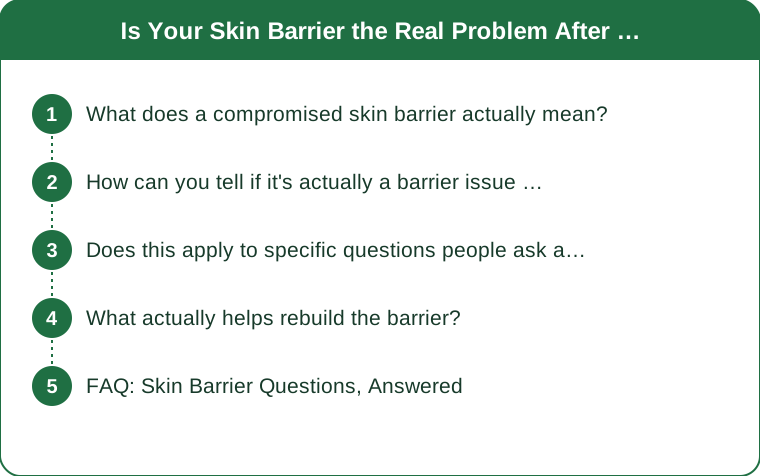
What does a compromised skin barrier actually mean?
The skin barrier is the outermost layer that holds moisture in and irritants out — when it weakens, water escapes faster and irritants penetrate more easily, which shows up as stinging, redness, flaking, and sudden reactivity to products that never bothered you before.
After 40, natural barrier lipid production tends to decline, which is a normal part of skin aging but means the same skincare routine that worked at 35 can start overwhelming a thinner, less resilient barrier.
How can you tell if it’s actually a barrier issue and not a new allergy?
Sudden, broad reactivity across multiple products (not just one new item) points more toward barrier compromise than an actual allergy, which is typically product-specific. A true allergy usually reacts to one ingredient consistently; a compromised barrier reacts to almost everything, including things you’ve used for years without issue.
A simple test: stop all active ingredients (retinoids, acids, strong vitamin C) for 1-2 weeks and use only a gentle cleanser and plain moisturizer. If sensitivity improves significantly, that points strongly to barrier compromise rather than a new allergy.

Does this apply to specific questions people ask about their routine?
‘Why does my retinol suddenly burn when it never used to?’ — often barrier thinning combined with the retinol’s normal exfoliating effect, which a healthy barrier used to buffer better.
‘Why is my skin flaky even though I moisturize daily?’ — a compromised barrier can leak moisture faster than a standard moisturizer replaces it, meaning the same routine that once worked needs richer, barrier-specific ingredients now, not more of the same product.
‘Why does a new sunscreen sting when old ones didn’t?’ — reduced barrier function lets active ingredients penetrate deeper and irritate more, independent of whether the sunscreen formula itself changed.
What actually helps rebuild the barrier?
Ceramides, cholesterol, and fatty acids in that combination (the actual lipids the barrier is made of) in a moisturizer tend to support barrier repair more directly than more general hydrating ingredients like hyaluronic acid alone.
Simplifying the routine temporarily — dropping to a gentle cleanser, a barrier-repair moisturizer, and sunscreen only, for 2-4 weeks — gives the barrier room to recover before slowly reintroducing actives one at a time, watching for reactions.
FAQ: Skin Barrier Questions, Answered
How long does it take to repair a damaged skin barrier?
Most people see meaningful improvement within 2-4 weeks of a simplified, barrier-focused routine, though more significant damage can take 6-8 weeks to fully stabilize.
Should you stop all actives permanently if you have barrier issues?
No — the goal is usually to reintroduce actives gradually once the barrier recovers, not eliminate them forever. Reintroduce one at a time, a few days apart, to identify what your skin currently tolerates.
Is barrier damage after 40 preventable?
Not entirely, since some decline is a normal part of skin aging, but gentler cleansing, avoiding over-exfoliation, and proactively using barrier-supporting moisturizers before problems start can meaningfully slow the visible impact. This is general information, not medical advice — persistent or severe skin reactions are worth a dermatologist visit.
TL;DR:
- Sudden reactivity across multiple products, not just one, points to barrier compromise over allergy
- A 1-2 week active-ingredient break is a reasonable simple test
- Ceramide and fatty-acid-rich moisturizers support barrier repair more directly than hydration alone
- Reintroduce actives one at a time after the barrier stabilizes
This is general information, not medical advice — persistent or severe reactions deserve a dermatologist’s input.
Keep Reading
This article is for general informational and styling purposes only. Fit, sizing, and product availability may vary.