Why Does My Skin Change the Week the Weather Does After 40?
Quick Answer: Falling humidity pulls moisture out of the skin’s outer layer, and after 40 there is less to lose — barrier lipids, natural moisturizing factors, and oil production have all declined. The routine that worked in August will usually be too light by October. The main changes are a richer moisturizer, gentler cleansing, and dialing back actives temporarily while the barrier adjusts.
One week your skin is fine. The next it is tight after cleansing, flaky around the nose, and your foundation is sitting in places it never used to.
Nothing changed except the weather — and after 40 that is enough.
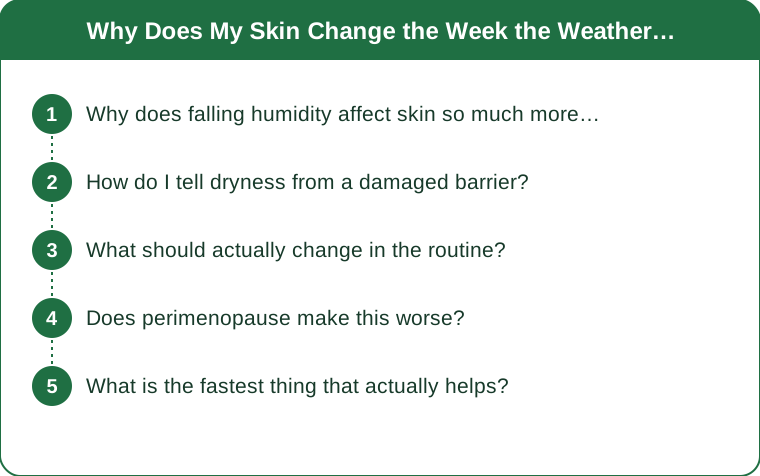
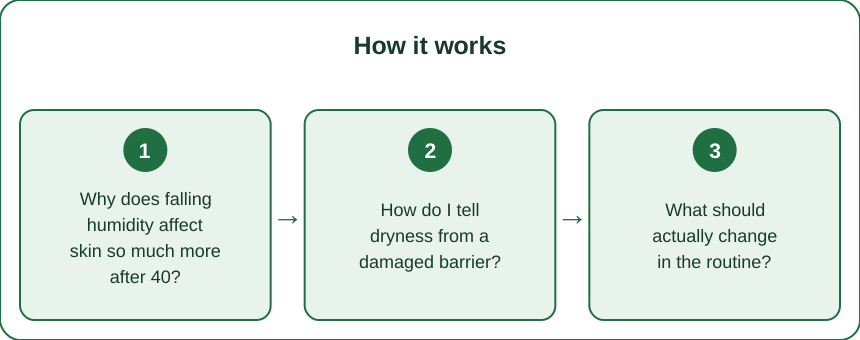
Why does falling humidity affect skin so much more after 40?
Because the skin’s ability to hold water declines, and lower humidity removes the margin.
Three things reduce with age, and all three matter here:
Barrier lipids. The outer layer of skin holds moisture using a lipid matrix — ceramides, cholesterol, fatty acids. Ceramide levels decline measurably with age, and the decline accelerates around perimenopause as estrogen falls. Less lipid means a leakier barrier.
Natural moisturizing factors. These are the water-binding compounds within skin cells, and their production also drops.
Sebum production. Oil output declines noticeably after 40 for most women. Sebum is not just an oiliness problem — it is part of the barrier, and less of it means faster water loss.
Now add the environmental change. Autumn brings lower absolute humidity outdoors and, once heating starts, dramatically lower humidity indoors. Indoor heated air in winter can drop to humidity levels comparable to a desert, and skin loses water to that air continuously.
In your twenties, ample sebum and intact barrier lipids absorbed that change. After 40, the buffer is thinner and the same environmental shift produces visible symptoms within days.
Why it feels sudden: barrier disruption compounds. A slightly compromised barrier loses more water, which further compromises it. The change is gradual for a week and then crosses a threshold where you can feel it.
How do I tell dryness from a damaged barrier?
They are different problems with different fixes, and this distinction resolves most autumn skincare confusion.
Simple dryness looks like: tightness, some flaking, dullness, makeup not sitting well. It responds quickly to richer moisturizer — better within a few days.
A damaged barrier looks like: stinging or burning from products you have used for years, redness, sensitivity to things that never bothered you, and rough texture that moisturizer does not fix. This is the one to take seriously, because continuing your normal routine on a damaged barrier makes it worse.
The single most reliable test: apply your usual serum. If a product you have used for months suddenly stings, that is barrier damage, not dryness.
Why autumn causes it after 40: the environmental drop plus a routine calibrated for summer plus continuing actives at summer intensity. Retinoids and exfoliating acids at the same strength that suited humid August often exceed what October skin tolerates.
What to do for a damaged barrier:
Stop all actives. Retinoids, acids, vitamin C, exfoliants — everything. Not reduce, stop.
Simplify to three steps: gentle cleanser, a barrier-repair moisturizer with ceramides, and sunscreen.
Give it two weeks. Barrier repair takes time and there is no shortcut.
Then reintroduce one active, at reduced frequency. Twice a week rather than nightly, and only after skin is calm.
If skin is severely inflamed, painful, or not improving after a few weeks of gentle care, see a dermatologist. This is general information, not medical advice.
What should actually change in the routine?
Cleanser: this is the first change and the most overlooked. A foaming or gel cleanser that felt perfect in humid summer will strip autumn skin. Switch to a cream, milk, or balm cleanser, and if your skin feels tight immediately after cleansing, the cleanser is too harsh regardless of what it claims.
Moisturizer: richer, and applied to damp skin. The texture that worked in August is likely too light. Look for ceramides, cholesterol, and fatty acids for barrier support, plus glycerin or hyaluronic acid for water binding — and note that humectants alone can make things worse in very dry air, because they pull water from deeper skin when there is none in the environment. Always seal a humectant with an occlusive layer in autumn.
Apply within a minute of cleansing, on damp skin. This single timing detail meaningfully improves how much water the skin retains.
Actives: reduce frequency, do not necessarily stop. If skin is intact, keep your retinoid but consider dropping from nightly to every other night through the transition. Buffer it — moisturizer, then retinoid, then moisturizer — which reduces irritation without much loss of effect.
Add an occlusive at night if you are very dry. A thin layer of an occlusive balm over moisturizer on the driest areas. This is unglamorous and highly effective.
Sunscreen: no change, and do not drop it. UV exposure declines but does not vanish, and the habit of skipping it once the weather cools is close to universal.
Body skin needs this too. The shins, forearms, and hands show autumn dryness first and get the least attention.
Does perimenopause make this worse?
Meaningfully, yes — and this is why the same seasonal change lands harder in the forties than it did in the thirties.
Estrogen supports skin in several ways at once: it contributes to collagen production, skin thickness, sebum production, and hydration. As estrogen declines through perimenopause, all of those decline together.
The frequently cited figure is that a substantial share of skin collagen is lost in the years immediately following menopause, with the fastest decline in the first five years. Skin becomes thinner, drier, and less able to buffer environmental change — which is exactly what a seasonal humidity drop tests.
What perimenopausal skin does that surprises people:
It can be dry and breaking out simultaneously. Shifting hormone ratios can drive adult acne at the same time as overall dryness increases. Treating it as oily skin is the common mistake and it makes the dryness considerably worse.
It becomes more reactive. Products tolerated for years can suddenly sting. This is genuine, not imagined.
It heals more slowly. A blemish or an irritation that resolved in three days now takes a week, which is a reason to be more careful rather than more aggressive.
What actually helps: consistency over intensity. A simple routine done reliably outperforms an elaborate one applied inconsistently, particularly during a transition. Retinoids remain the best-evidenced topical for aging skin, but the tolerable dose may now be lower than it was.
Hormone-related skin changes are worth discussing with a doctor, particularly if they arrive alongside other perimenopausal symptoms.
What is the fastest thing that actually helps?
A humidifier in the bedroom. This is the highest-return intervention available and it is not a skincare product.
You spend seven or eight hours a night in one room, and once heating starts that room’s humidity drops sharply. Raising bedroom humidity to a moderate level addresses the cause rather than compensating for it, and people consistently report it doing more than any product change.
Shorter, cooler showers. Hot water strips barrier lipids directly, and a long hot shower in autumn is one of the most reliably damaging daily habits. Warm rather than hot, and shorter than feels ideal.
Moisturize within 60 seconds of getting out. Applying to damp skin traps the water that is already there.
Stop exfoliating for two weeks and see what happens. Many autumn skin complaints are over-exfoliation that summer’s higher humidity was masking. This costs nothing and diagnoses a surprising share of problems.
Check what changed besides the weather. Heating going on, a new heavier fabric against the face, a change in water temperature, more indoor time. Skin problems that appear in a single week usually have an environmental cause rather than an internal one.
Is it too late to start a retinoid after 40?
No. Retinoids remain effective at any age, and starting in your forties or later still produces real benefit. Start at low strength, twice weekly, buffered with moisturizer — and not during a week when your barrier is already struggling.
Do I need different products or just more of them?
Usually a richer moisturizer and a gentler cleanser, rather than a whole new routine. The rest of what you use can generally stay.
How long until skin settles into the new season?
Usually two to three weeks once the routine is adjusted. If it is still unsettled after a month, the routine is likely still too harsh somewhere — most often the cleanser.
TL;DR: Lower humidity plus a thinner barrier is the whole mechanism.
- Three things declined: barrier ceramides, natural moisturizing factors, and sebum. Autumn removes the margin they used to provide.
- Distinguish dryness from barrier damage. If a product you have used for months suddenly stings, that is barrier damage — stop all actives for two weeks.
- Change the cleanser first. A stripping cleanser undoes everything that follows it.
- Seal humectants with an occlusive. In dry air, hyaluronic acid alone can pull water from deeper skin.
- Perimenopause makes this harder — thinner skin, slower healing, and dry-plus-breakouts at the same time.
- A bedroom humidifier does more than any product. It addresses the cause rather than compensating.
Moisturize within sixty seconds of your next shower, on damp skin. It is free and it is the fastest improvement on this list.
Keep Reading
This article is for general informational and styling purposes only. Fit, sizing, and product availability may vary.