Do Collagen Supplements Interact With Any Medications Common After 40? Here's What to Actually Check
Quick Answer: Collagen supplements are generally considered low-risk for most common medications, but calcium content in some collagen products can interact with certain antibiotics and thyroid medication by reducing absorption if taken too close together. Checking the specific product’s added ingredients (not just “collagen” itself) and spacing supplement timing 2-4 hours from these medication types is the main precaution worth knowing.
Collagen supplements get marketed as close to risk-free, and for most people that’s a fair characterization — but “most people” isn’t “everyone,” and a couple of specific medication categories are worth a direct check.

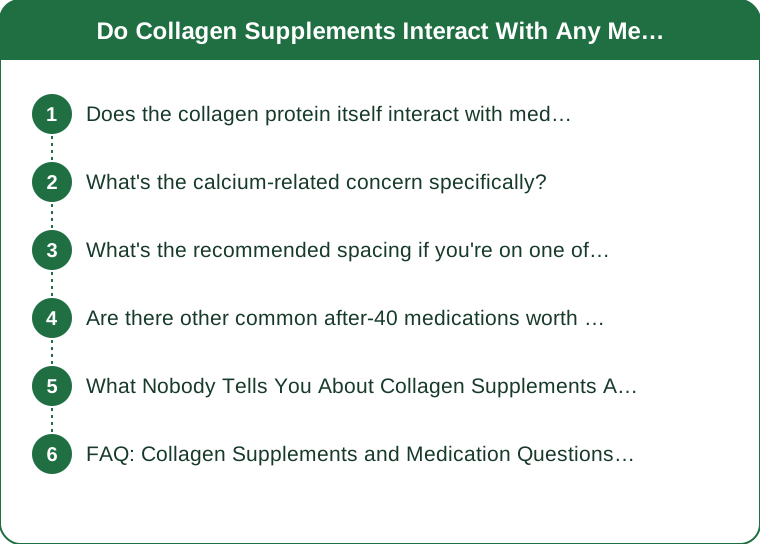
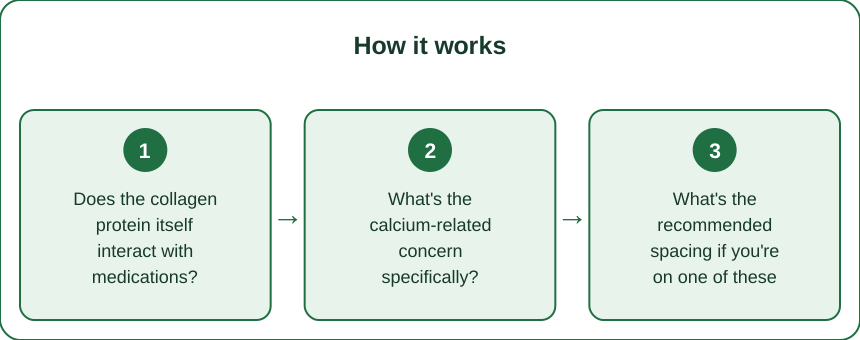
Does the collagen protein itself interact with medications?
Collagen protein by itself has a low reported interaction profile with most common medications — most of the caution that does exist relates to added ingredients in the supplement formula (calcium, vitamin C, added minerals) rather than the collagen protein itself.
What’s the calcium-related concern specifically?
Some collagen supplements are formulated with added calcium, and calcium is known to reduce absorption of certain antibiotics (particularly some in the tetracycline and fluoroquinolone classes) and thyroid medication (levothyroxine) if taken too close together — this isn’t unique to collagen, it’s the same general calcium-and-medication timing consideration that applies to calcium supplements or calcium-fortified foods generally.
What’s the recommended spacing if you’re on one of these medications?
A 2-4 hour gap between a calcium-containing collagen supplement and these medication types is the standard guidance, similar to general calcium supplement timing advice — taking thyroid medication first thing in the morning and a collagen supplement at lunch, for instance, avoids the overlap.

Are there other common after-40 medications worth checking against?
Blood thinners and blood pressure medications don’t have a strong documented interaction with collagen specifically, though as with any new supplement, checking with a pharmacist when starting one alongside an existing prescription is the more reliable approach than assuming based on general supplement categories.
What Nobody Tells You About Collagen Supplements After 40
Not all collagen supplements are formulated the same way — a plain hydrolyzed collagen peptide powder with no added ingredients carries a different (generally lower) interaction profile than a “beauty blend” product with added vitamins and minerals, so reading the full ingredient list matters more than the word “collagen” on the front label.
Vitamin C is commonly added to collagen supplements to support absorption, and while generally low-risk, very high-dose vitamin C can interact with certain medications too, which is another reason to check the full label rather than assuming a collagen product is a single, simple ingredient.
Pharmacists are consistently the fastest, most direct resource for this kind of question — checking with one when starting a new supplement, especially alongside an existing prescription, is more reliable than researching general interaction patterns online.
FAQ: Collagen Supplements and Medication Questions, Answered
Is it safer to take a plain collagen powder instead of a formulated blend?
Generally yes, from a pure interaction-risk standpoint, since a plain product has fewer added ingredients to check against your specific medications.
Does the timing precaution apply to collagen in food (bone broth) as well as supplements?
The same general calcium-timing principle applies to any meaningful calcium source, though supplement doses are often more concentrated and standardized than food sources.
Should I stop taking my thyroid medication if I want to add a collagen supplement?
No — never stop a prescribed medication without medical guidance; the fix here is timing separation, not discontinuing either product. This is general information, not medical advice — check your specific medications with a doctor or pharmacist.
TL;DR:
- Collagen protein itself has a low interaction profile with most common medications
- Added calcium in some collagen products can reduce absorption of certain antibiotics and thyroid medication
- A 2-4 hour spacing between a calcium-containing supplement and these medications is standard guidance
- Checking the full ingredient list, not just the word “collagen,” and asking a pharmacist covers most bases
Collagen supplements are low-risk for most people after 40, but a quick label check and a pharmacist conversation close the small gap that general marketing doesn’t cover.
Keep Reading
This article is for general informational and styling purposes only. Fit, sizing, and product availability may vary.