Does Vitamin D Actually Affect Skin Health After 40?
Quick Answer: Vitamin D plays a genuine role in skin cell turnover, barrier function, and wound healing, and since vitamin D deficiency becomes more common after 40 (partly due to skin’s declining natural synthesis efficiency with age), a real deficiency can plausibly contribute to slower healing, increased dryness, or a duller overall appearance — though it’s one contributing factor among several, not a single explanation for post-40 skin changes on its own.
The connection is real but often oversimplified in skincare marketing, which is worth untangling before assuming a supplement alone will meaningfully change how skin looks.

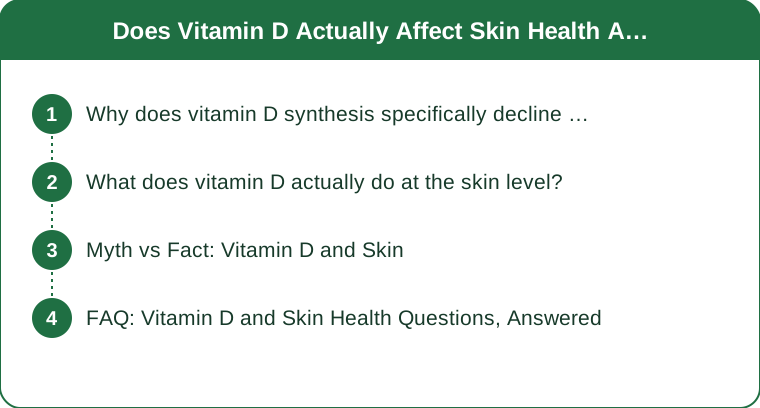
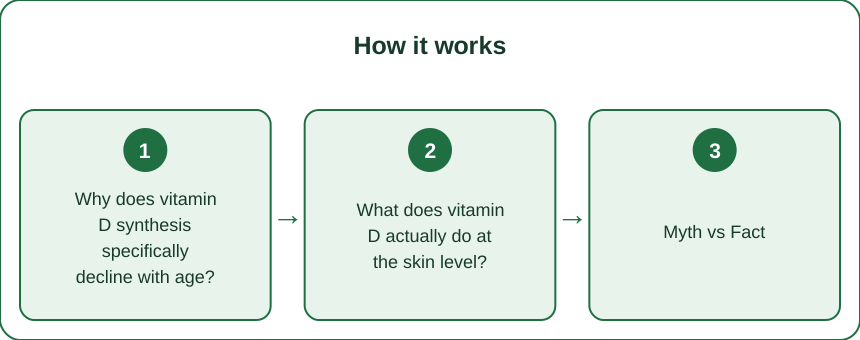
Why does vitamin D synthesis specifically decline with age?
Skin’s capacity to convert sunlight into usable vitamin D decreases measurably with age due to thinning of the skin layer where that conversion happens, meaning even with similar sun exposure to earlier decades, someone in their 40s and beyond may synthesize meaningfully less vitamin D than they did when younger — this is part of why deficiency becomes more common in this age range specifically.
What does vitamin D actually do at the skin level?
Vitamin D receptors are present throughout skin cells and play a role in regulating cell turnover and supporting the skin’s barrier function (its ability to retain moisture and defend against irritants) — a genuine deficiency can plausibly show up as slower cell turnover, more noticeable dryness, or slower healing from minor irritation.

Myth vs Fact: Vitamin D and Skin
Myth: taking a vitamin D supplement will visibly change your skin’s appearance within days or weeks. Fact: correcting an actual deficiency, if one exists, generally shows gradual improvement in skin barrier function over a period of months, not an immediate visible transformation.
Myth: more sun exposure is a good way to boost vitamin D and improve skin. Fact: while sun exposure does trigger vitamin D synthesis, UV exposure is also the primary driver of visible skin aging and damage, making it a poor strategy overall compared to dietary sources or supplementation.
Myth: everyone over 40 is vitamin D deficient. Fact: deficiency is more common in this age range but far from universal — actual bloodwork, not age alone, is the only reliable way to know your specific status.
FAQ: Vitamin D and Skin Health Questions, Answered
How do I actually find out if I’m vitamin D deficient?
A simple blood test (25-hydroxyvitamin D) ordered by a doctor is the only reliable way to know your actual level — guessing based on age or symptoms alone isn’t a substitute for the test.
If my levels are already normal, will extra vitamin D still improve my skin further?
There’s limited evidence that supplementing beyond a normal, sufficient level provides additional skin benefit — the meaningful improvements are generally seen when correcting an actual deficiency, not from exceeding normal levels.
Are there topical vitamin D skincare products worth trying separately from supplements?
Some topical vitamin D derivatives are used in specific dermatological treatments (certain prescription options for skin conditions), but over-the-counter cosmetic products with vitamin D generally have limited evidence for meaningfully changing skin appearance on their own compared to addressing an actual systemic deficiency.
TL;DR:
- Skin’s natural vitamin D synthesis efficiency genuinely declines with age
- Vitamin D supports skin cell turnover, barrier function, and healing at a cellular level
- A confirmed deficiency, corrected with supplementation, may gradually improve skin barrier function
- A blood test, not age or symptoms alone, is the only reliable way to know your actual status
Vitamin D’s connection to post-40 skin health is real but specific — worth checking with an actual test rather than assuming a supplement alone will visibly transform your skin.
Keep Reading
This article is for general informational and styling purposes only. Fit, sizing, and product availability may vary.