Why Sunscreen Pills Over Makeup After 40: Questions Answered
Quick Answer: Pilling is when layered products fail to bind and roll into small clumps under friction. It happens most when a silicone-based product goes over a water-based one, when layers are applied before the one underneath has set, when too much product is used, or when dry flaky skin gives the layers nothing smooth to sit on. After 40 the last of those becomes far more common as barrier function and cell turnover change. The fix is fewer layers, thinner amounts, 60 to 90 seconds between them, and matching bases.
You did everything right and it rolled off in grey threads.
It is not the sunscreen. It is what is underneath and how fast you got there.
This is general information, not medical advice.

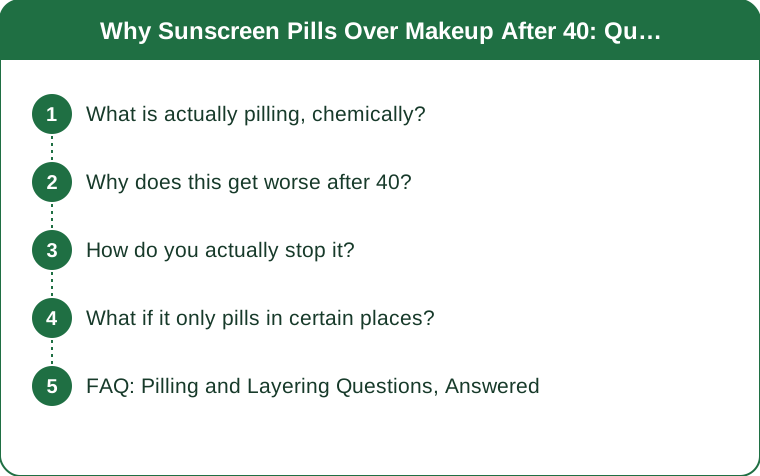
What is actually pilling, chemically?
Two films that will not merge, plus friction.
Every skincare product dries into a thin film. When you apply a second product on top, one of two things happens: the films merge into a single layer, or they sit as two separate layers with a boundary between them.
Merging requires compatibility. Water-based products merge readily with other water-based products. Silicone-based products merge with other silicone-based ones. A silicone film over a water-based film that has not fully set does not merge - it floats.
Then your finger, a brush, or a sponge applies lateral force, and the top film rolls. Those grey or white threads are the physical product, balled up. The name pilling comes from fabric, and the mechanism is genuinely similar.
The four conditions that produce it, in order of how often they are the culprit:
- Not enough time between layers. A film that is still wet cannot support another film. This is the single most common cause.
- Too much product. A thick film has more mass to roll and less contact with what is beneath it.
- Incompatible bases. Silicone over water, or a heavy occlusive over a lightweight serum.
- Flaky skin underneath. Dead cell clusters lift, and the products lift with them.
How to tell which one you have: if it pills immediately and evenly, it is timing or amount. If it pills only where you rubbed, it is friction and the film is too thick. If it pills in specific patches - around the nose, on the cheeks - it is dry or flaking skin underneath and the products are not the problem at all.
Why does this get worse after 40?
Because the surface changes in three ways that all make films sit less evenly.
Cell turnover slows. The rate at which dead surface cells shed declines steadily with age - meaningfully so by the forties. Retained dead cells sit in clusters rather than shedding evenly, and a product film laid over a cluster has a weak point built into it.
Barrier function and lipid content decline. Skin holds less water and the surface becomes drier, particularly after perimenopause begins to affect oestrogen levels. Dry skin flakes; flakes lift; layers lift with them.
And the routine gets longer. This is the underrated factor. A twenty-something using a moisturiser and a sunscreen has two films to reconcile. A forty-something using an antioxidant serum, a hydrating serum, a peptide, an eye cream, a moisturiser and a sunscreen has six - and each boundary is an opportunity to fail.
The specific ingredient combinations that pill most often:
- Silicone-heavy primers or sunscreens over water-based hyaluronic serums
- Anything over a thick occlusive applied as the last skincare step
- Mineral sunscreens over heavy moisturisers, since zinc and titanium formulas sit as a distinct physical layer
- Products with high concentrations of film-forming polymers, common in long-wear and blur-effect formulas
Retinoid users have an extra factor. Retinoids increase surface flaking during the adjustment period and intermittently afterwards, which is a direct pilling cause. The pilling is a symptom of the flaking, and treating the flaking is the actual fix.

How do you actually stop it?
Fewer layers, less product, more time, matched bases - roughly in that order of effect.
Cut the number of layers. This is the highest-return change and the one people resist most. A six-step morning routine is not obviously better than a three-step one, and every removed layer removes a boundary. Move actives to the evening and keep the morning to hydration, moisturiser, sunscreen.
Use less. Most people over-apply serums considerably - a pea-sized amount covers the whole face for most formulas. The exception is sunscreen, where you need the full amount for the protection to be real, roughly a quarter teaspoon for the face. So reduce everything else and leave the sunscreen alone.
Wait between layers. 60 to 90 seconds is usually enough for a serum, longer for a rich cream. The test is touch: if it feels tacky, it has not set. This is unglamorous and it fixes most pilling on its own.
Match the bases. Check the first few ingredients. If dimethicone or another silicone appears near the top, that product wants silicone-based neighbours. If it is mostly water and humectants, keep it with similar products. When in doubt, thinnest to thickest.
Application technique matters more than expected:
- Press and pat rather than rub, especially for the final layers
- Apply sunscreen in sections rather than spreading one blob across the whole face
- Do not go back over an area once it has started to set
- Warm product between palms first, which helps it spread with less friction
And address the skin itself. Gentle chemical exfoliation two to three times a week - a low-strength lactic or mandelic acid - removes the dead-cell clusters that cause patchy pilling. Physical scrubs are the wrong tool here and often make the flaking worse.
What if it only pills in certain places?
Then it is your skin, not your products, and the fix is different.
Patchy pilling has a diagnostic value. If the same areas fail every day while the rest of the face is fine, the products are compatible and something local is happening.
The usual locations and what they mean:
- Around the nose and nostril creases - the most common site, usually retained flaking plus higher friction
- On the cheeks in defined patches - dry areas or an eczema-type flare
- Along the jaw and hairline - product build-up from incomplete cleansing
- Around the mouth - often retinoid-related flaking, since this area is where irritation shows first
The treatment sequence for patchy pilling:
- Stop exfoliating for a week if you have been doing it aggressively, since over-exfoliation causes flaking too
- Increase hydration - a humectant serum on damp skin, and a richer moisturiser at night
- Reintroduce gentle chemical exfoliation at two nights a week once the skin is calm
- Then reassess the layering, which will often have resolved itself
The counterintuitive part is that more exfoliation is frequently the wrong answer. Flaking from a damaged barrier looks identical to flaking from retained dead cells, and scrubbing a compromised barrier makes it flake more. If your skin also stings with products or feels tight after cleansing, treat it as barrier damage first.
On makeup specifically: if skincare sits fine and only makeup pills, the boundary is between your last skincare step and the foundation. Waiting longer before makeup, and choosing a foundation with a matching base to your sunscreen, resolves most of it.
FAQ: Pilling and Layering Questions, Answered
How long should I wait between layers?
Around 60 to 90 seconds for a lightweight serum and longer for a rich cream. The reliable test is touch - if the skin still feels tacky, the film has not set and the next layer will float on it rather than bind.
Is it the sunscreen’s fault?
Usually not. Sunscreen is the last layer, so it is where the failure becomes visible, but the cause is almost always what is underneath or how quickly it went on. Try the same sunscreen on bare skin - if it behaves, the sunscreen is fine.
Should I use less sunscreen to stop pilling?
No. Sunscreen protection depends on applying the full amount, roughly a quarter teaspoon for the face. Reduce the layers underneath instead, and apply the sunscreen in sections rather than all at once.
Why does this only happen to me now, not in my thirties?
Cell turnover slows and skin holds less water with age, so the surface is less even and more prone to flaking. Routines also tend to get longer after 40, and every additional layer adds a boundary where two films can fail to merge.
Will exfoliating more fix it?
Sometimes, and sometimes it makes it worse. If the flaking comes from retained dead cells, gentle chemical exfoliation two to three times a week helps. If it comes from a damaged barrier, more exfoliation worsens it. Tight or stinging skin points to the second.
How do I know if two products will conflict?
Check the top few ingredients. Silicones like dimethicone want silicone-based neighbours; water-and-humectant formulas want similar ones. When mixing is unavoidable, go thinnest to thickest and allow more time between them.
TL;DR:
- Pilling is two product films failing to merge, then rolling under friction
- The top cause is not waiting long enough - 60 to 90 seconds, until the skin is not tacky
- Then: too much product, mismatched silicone-over-water bases, and flaky skin underneath
- After 40, slower turnover and drier skin make the surface less even, and routines get longer
- Cut layers in the morning, use less of everything except sunscreen, press rather than rub
- Patchy pilling in the same spots is a skin problem, not a product problem
- Tight or stinging skin means barrier damage - hydrate before exfoliating
Fewer layers, thinner amounts, more patience. That is most of it.
Keep Reading
This article is for general informational and styling purposes only. Fit, sizing, and product availability may vary.