Why Does Your Skin React Differently in Late Summer After 40?
Quick Answer: After 40, skin holds onto the cumulative effects of a summer rather than bouncing back from them, because barrier repair slows, sebum composition shifts, and the pigment response from summer UV surfaces weeks after the exposure. The late-August version of this is a barrier that is simultaneously dehydrated and congested, plus dark spots appearing now from June sun. The response is barrier repair first and active ingredients second - in that order, not both at once.
This is general information, not medical advice - see a dermatologist for anything changing rapidly or unusually.

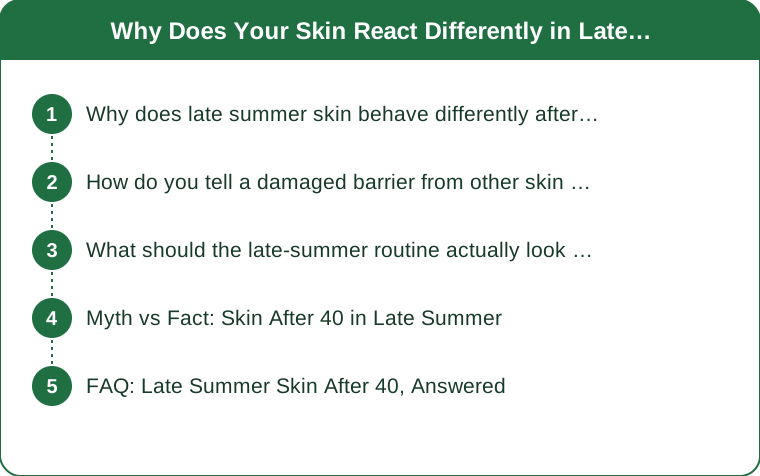
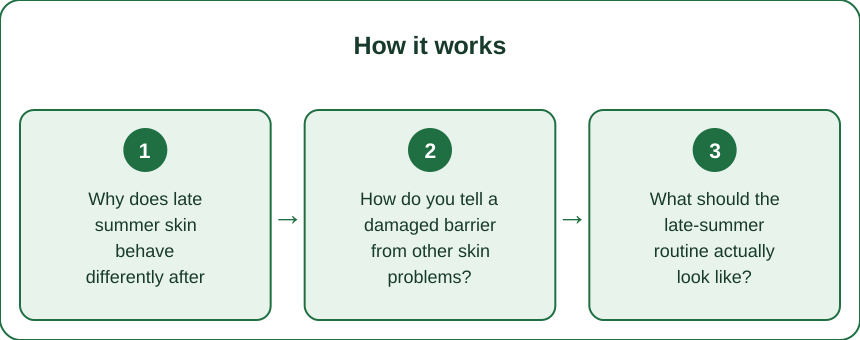
Why does late summer skin behave differently after 40?
Because three separate changes stack in exactly this season.
Barrier repair slows measurably with age. In younger skin, barrier recovery after disruption takes roughly 3 days. After 40 and particularly through perimenopause, the same recovery often takes 5 to 7 days. A summer of sun, chlorine, salt water, air conditioning, and heat is a series of small disruptions - and when repair is slower than the rate of disruption, the deficit accumulates across the whole season.
Sebum composition changes, not just quantity. Declining oestrogen affects skin lipids. Ceramide content in the stratum corneum falls with age, which is the specific reason skin can be oily and dehydrated simultaneously - a combination that genuinely confuses people who spent their thirties in one camp or the other.
Pigment responses are delayed. Melanin production from UV exposure continues developing for weeks after the exposure itself. Sun from June and July surfaces as visible pigment in late August and September, which is why so many people conclude that their spots appeared for no reason. There was a reason; it was ten weeks ago.
What this stacks into, in practice:
- Skin that feels tight but looks shiny, which is barrier dysfunction rather than an oil problem
- Products that used to be fine now stinging, which is the classic sign of a compromised barrier
- New or darkened pigmentation appearing without recent obvious sun
- Rough texture and flaking despite an intact routine
- Slower recovery from any irritation - a spot that would have gone in three days now takes a fortnight
The important reframe. None of this means your routine stopped working. It means the same routine now sits on skin with less reserve. The routine needs adjusting to the skin, not replacing wholesale - which is what most people do, usually making it worse.
How do you tell a damaged barrier from other skin problems?
By the pattern of symptoms rather than any single one.
The signs that indicate barrier disruption specifically:
- Stinging or burning from products you have used for months. This is the most reliable single indicator
- Tightness after cleansing that persists more than a few minutes
- Skin that feels rough to the touch but does not look obviously flaky
- Redness that comes and goes without a clear trigger
- Increased sensitivity to temperature changes, particularly moving between air conditioning and heat
- Oiliness alongside tightness, which is the confusing combination and a strong barrier signal
What distinguishes it from other things:
- Allergic contact dermatitis typically appears in a defined area matching where a product went, with itching prominent
- Perioral dermatitis clusters around the mouth and nose, often with small bumps, and is frequently made worse by heavy moisturisers - this one needs a doctor
- Rosacea involves flushing, visible vessels, and often triggers like heat, alcohol, or spice
- Simple dehydration improves within days of adding humectants; barrier damage does not
The most useful diagnostic: the simplify test. Reduce to a gentle cleanser, a bland moisturiser, and sunscreen for 7 to 10 days. Nothing else - no acids, no retinoid, no vitamin C, no exfoliation.
- If it improves substantially, it was barrier disruption, most likely from over-treatment
- If nothing changes, something else is happening and it is worth seeing a professional
When to see a dermatologist rather than experimenting: any rash that spreads, a lesion that changes in size, shape, or colour, persistent burning without visible cause, or anything not improving after two weeks of simplification. Changing moles specifically warrant prompt attention and should never be watched hopefully. This is general information rather than medical advice.

What should the late-summer routine actually look like?
Repair first, actives second, and resist doing both at once.
Phase one, roughly two weeks: rebuild.
- A cream or oil cleanser rather than a foaming one. Sulphate-based foaming cleansers strip lipids that are already depleted
- Lukewarm water. Hot water measurably disrupts barrier lipids, and in late summer people wash hot without noticing
- A moisturiser containing ceramides, ideally with cholesterol and fatty acids too. The ratio matters - formulations that include all three repair faster than ceramides alone
- Humectants under the moisturiser - glycerin or hyaluronic acid - applied to damp skin
- Sunscreen every morning without exception. UV both prevents repair and drives the pigment problem
- Nothing else. No acids, no retinoid, no vitamin C, no scrubs, no cleansing devices
Phase two: reintroduce, one thing at a time.
- Wait for stinging to stop entirely before reintroducing anything
- Add one active and hold for two weeks before adding another. Two at once means you learn nothing when it goes wrong
- Start at low frequency - a retinoid twice weekly, not nightly, regardless of what you previously tolerated
- Buffer if needed - moisturiser before the active reduces irritation with a modest reduction in effect, which is a good trade during rebuilding
For the pigmentation specifically, once the barrier is stable:
- Sunscreen is the treatment, not just prevention. Existing pigment darkens with ongoing exposure, so nothing else works without it
- Niacinamide at 4 to 5 percent is well tolerated and interferes with pigment transfer to skin cells
- Vitamin C in the morning for both antioxidant protection and gradual brightening
- Azelaic acid is unusually well tolerated for pigment work and generally kinder than hydroquinone alternatives
- Expect 8 to 12 weeks for visible change. Pigment work is slow in every skin and slower after 40, and abandoning it at week four is the most common failure
The frequency change that surprises people. Retinoid tolerance genuinely decreases after 40, in line with slower barrier repair. Three nights a week of consistent use beats nightly use interrupted every fortnight by irritation. Total exposure over a year is what matters, and that favours the sustainable frequency.
Myth vs Fact: Skin After 40 in Late Summer
Myth: If your skin is oily, the barrier is fine. Fact: Oil production and barrier integrity are largely separate. Falling ceramide levels mean skin can produce plenty of sebum while failing to hold water in. The tight-but-shiny combination is the specific signature, and treating it as an oil problem makes it worse.
Myth: Dark spots appearing now are from recent sun. Fact: Melanin production continues developing for weeks after exposure. Late August pigment is typically June and July sun surfacing, which is why it seems to appear from nowhere - and why sun protection in spring matters for how your face looks in autumn.
Myth: Stronger actives are needed as skin ages. Fact: Slower barrier repair means the same concentration is effectively harsher than it was ten years ago. Most people over 40 with irritated skin are over-treating, not under-treating. Frequency and consistency beat strength.
Myth: You should exfoliate more when skin is rough and flaky. Fact: Roughness in a compromised barrier is usually dysfunctional desquamation, not build-up. Exfoliating it accelerates the damage. Rebuild first; the roughness typically resolves without exfoliation at all.
Myth: Expensive products repair barriers faster. Fact: The evidence supports specific ingredients - ceramides, cholesterol, fatty acids, glycerin, niacinamide - all of which appear in inexpensive formulations. Barrier repair is one of the areas where price and outcome correlate least.
FAQ: Late Summer Skin After 40, Answered
How long does barrier repair take after 40?
Typically 5 to 7 days for a mild disruption, versus around 3 in younger skin, and 2 to 4 weeks for a barrier compromised across a whole season. The most common error is reintroducing actives at day 4 and restarting the cycle.
Why is my skin oily and tight at the same time?
That combination is the signature of barrier dysfunction with adequate sebum. Ceramide levels fall with age, so skin loses water through the barrier while still producing oil. Treat it as a barrier problem, not an oil problem.
Why are dark spots showing up now when I was careful this summer?
Pigment from UV exposure continues developing for weeks afterwards. What surfaces in late August is usually June and July sun. It is also why consistent daily sunscreen matters more than avoiding one intense day.
Can I keep using retinol while repairing my barrier?
Better not to. Stop entirely for 10 to 14 days, then restart at two nights a week and build slowly. Retinoid tolerance genuinely decreases after 40, and three consistent nights weekly beats nightly use interrupted by irritation.
How long until pigmentation treatment shows results?
Eight to twelve weeks with consistent use and daily sunscreen. Most people stop at four to six weeks and conclude it did not work. Sunscreen is not optional here - without it, nothing else does anything.
When should I see a dermatologist instead of adjusting my routine?
Any mole or lesion changing in size, shape, or colour; a rash that spreads; persistent burning without visible cause; or no improvement after two weeks of a simplified routine. Changing lesions warrant prompt attention rather than watchful waiting.
TL;DR:
- Barrier repair slows from around 3 days to 5 to 7 after 40, so a summer of small disruptions accumulates
- Tight-but-shiny is barrier dysfunction, not an oil problem - falling ceramides are the mechanism
- Late August pigment is usually June and July sun surfacing weeks later
- Simplify for 10 to 14 days - gentle cleanser, ceramide moisturiser, sunscreen - then reintroduce one active at a time
- Pigment work takes 8 to 12 weeks and does nothing without daily sunscreen
The routine did not stop working. It is sitting on skin with less reserve than it used to have, and the fix is almost always doing less for a fortnight rather than more.
Keep Reading
This article is for general informational and styling purposes only. Fit, sizing, and product availability may vary.