Why the Same Skincare Routine That Worked for Years Suddenly Stopped Working in Your Forties
Quick Answer: Skin in your forties undergoes real, measurable changes — declining collagen production, slower cell turnover, and shifting oil production tied to hormonal changes — so a routine built for skin’s needs at thirty genuinely stops matching skin’s needs at forty-five, and the fix is usually adjusting active ingredients and hydration approach, not finding a completely different routine philosophy.
It’s not that the routine got worse or that your skin got harder to please — the underlying biology it’s working with has measurably shifted.
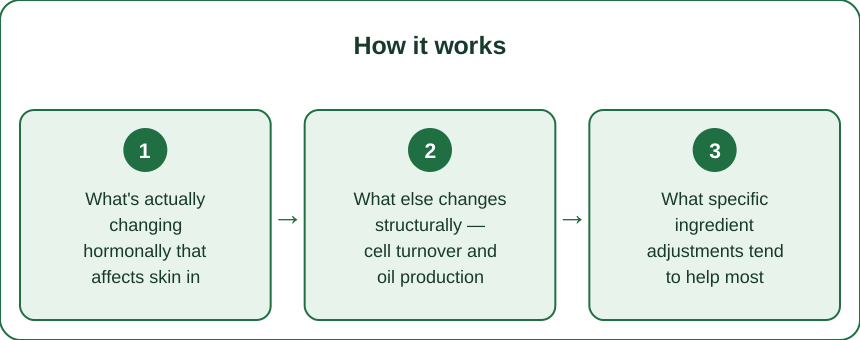
What’s actually changing hormonally that affects skin in your forties?
Perimenopause, which for many women begins sometime in the forties, involves declining and increasingly fluctuating estrogen levels, and estrogen plays a direct, well-documented role in skin collagen production, oil regulation, and moisture retention — as estrogen shifts, skin’s collagen synthesis rate and natural oil production both measurably decline, independent of anything about the skincare routine itself.
What else changes structurally — cell turnover and oil production
Does collagen decline happen gradually or is there a specific inflection point?
Research on skin aging generally finds collagen production declines gradually from the late twenties onward, but the rate of decline accelerates measurably around perimenopause specifically due to the estrogen connection — which is part of why the change can feel more sudden in the forties than the truly gradual decline in the decade before.
How does slower cell turnover change what a routine needs to do?
Skin cell turnover rate slows with age, meaning dead skin cells remain on the surface longer before naturally shedding — a routine that didn’t previously need a dedicated exfoliation or cell-turnover-supporting ingredient (like a retinoid) often benefits from adding one specifically to compensate for this slower natural process.
Does oil production changing affect which product textures actually work now?
Yes — many women experience genuinely reduced natural oil production through this hormonal transition, meaning a lightweight lotion that provided adequate hydration in the thirties may simply no longer provide enough moisture barrier support, independent of the product’s quality — richer textures or an added hydrating serum step often become necessary, not just preferable.

What specific ingredient adjustments tend to help most during this transition?
Dermatologists commonly recommend adding or increasing retinoid use (to support cell turnover and collagen signaling), layering in a hyaluronic acid serum (to address increased moisture needs), and reassessing SPF and antioxidant use, since cumulative sun damage becomes a larger relative factor in visible skin changes as natural collagen production declines.
Is it normal for previously well-tolerated products to suddenly cause irritation in your forties?
Yes, reasonably common — as the skin barrier’s natural oil production and moisture retention shift, the same product formulation can behave differently on the same skin than it did years earlier, which is why some women find they need to introduce active ingredients more gradually or switch to gentler formulations during this transition, even for products previously well-tolerated.
FAQ: Skincare Changes in Your Forties, Answered
Is it necessary to completely replace a skincare routine in your forties, or just adjust it?
For most people, targeted adjustment (adding a retinoid, increasing hydration, reassessing SPF) is more appropriate than a complete overhaul, since much of a well-built existing routine likely still serves a real purpose.
Should these routine adjustments start before noticeable changes appear, or only after?
Many dermatologists recommend beginning to adjust proactively in the early-to-mid forties, since some changes (like collagen decline) are gradual and preventive adjustment tends to produce better long-term results than waiting for visible change to prompt a reaction.
Is it worth consulting a dermatologist specifically for this transition rather than adjusting independently?
Yes, particularly if skin changes are significant or accompanied by other perimenopause symptoms — a dermatologist can recommend a more personalized ingredient and routine adjustment than general guidance alone, and can also rule out other causes for sudden skin changes. This is general information, not medical advice.
TL;DR:
- Declining, fluctuating estrogen in your forties directly affects collagen, oil, and moisture
- Slower cell turnover means exfoliation or a retinoid often becomes more necessary, not optional
- Reduced natural oil production often means richer textures are genuinely needed, not just nicer
- Previously well-tolerated products can start behaving differently as the skin barrier shifts
This is general information, not medical advice — significant or sudden skin changes are worth a dermatologist visit.
Keep Reading
This article is for general informational and styling purposes only. Fit, sizing, and product availability may vary.