Why Do Your Under-Eyes Look Drier After 40?
Quick Answer: Under-eye skin is the thinnest on the body - around 0.5 mm versus 2 mm elsewhere - and it has very few oil glands. After 40, declining estrogen reduces skin hydration and collagen production, which hits the thinnest area first and hardest. The result is visible crepiness and product that stops working. What helps: occlusive moisture rather than lightweight gels, a humectant applied to damp skin, and sun protection, which prevents more of this than any eye cream reverses.
The frustrating part is the timeline. Nothing changed in what you use, and yet the same eye cream you have relied on for a decade now sits on the surface and does nothing.
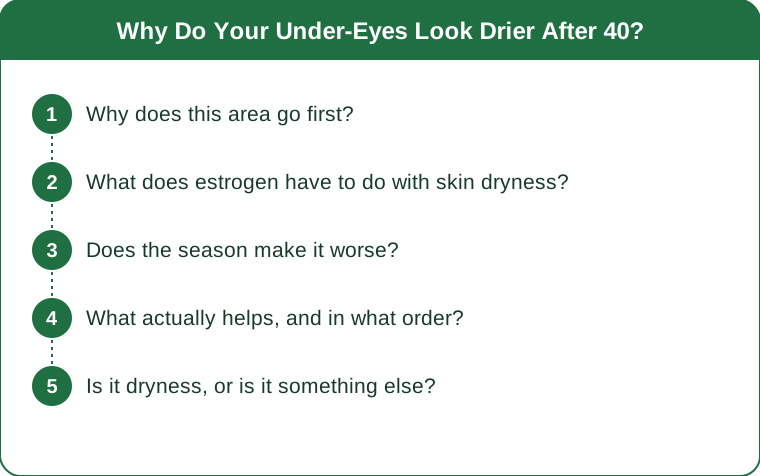
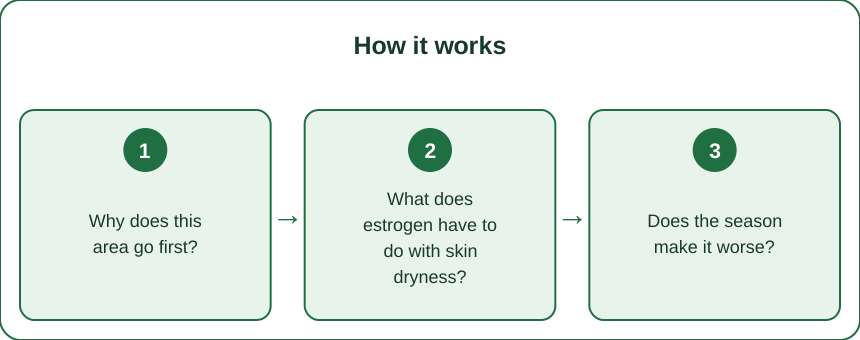
Why does this area go first?
Because it starts with the least of everything the skin needs to hold moisture.
The skin under the eye is about a quarter the thickness of facial skin elsewhere - roughly 0.5 mm compared to 2 mm on the cheek. There is simply less tissue to hold water.
It has almost no sebaceous glands. Oil is what slows water loss from the skin surface. The under-eye has very few glands, so it relies almost entirely on whatever barrier lipids are present - and those decline with age.
It moves constantly. You blink somewhere between 15,000 and 20,000 times a day, and every blink flexes this skin. Mechanical stress on thin, dry tissue is what produces the fine crepey texture.
Blood vessels sit close to the surface. Which is why the same area shows darkness and puffiness readily, and why dryness here reads as tired rather than just dry.
So it is not that this area aged faster. It had the least reserve to begin with, so the same systemic change shows here first.
What does estrogen have to do with skin dryness?
A great deal, and this is the mechanism that explains the timing.
Estrogen supports collagen production, skin thickness, and hydration. As levels decline through perimenopause and after, all three decrease. Research commonly cites a loss of around 30% of skin collagen in the first five years after menopause, with a slower ongoing decline afterward.
Hyaluronic acid content in the skin falls too. Hyaluronic acid holds water in the dermis, and less of it means less water held in the tissue independent of anything you apply topically.
Barrier function weakens. The skin’s ability to prevent water loss depends on ceramides and other lipids that also decline. A weaker barrier loses water faster all day, which is why skin can feel fine after application and dry three hours later.
The change is not linear. Many people notice a relatively sudden shift over a year or two rather than gradual change, which matches the pace of hormonal transition rather than chronological aging.
And it affects how products perform. A lightweight gel that worked on skin with a good barrier may do nothing on skin that is losing water faster than the product can supply it.
Does the season make it worse?
Noticeably, and late summer into autumn is one of the two hard transitions each year.
Humidity drops as the season turns. Skin loses water to dry air, and the gradient steepens as outdoor humidity falls. This is why the same routine that worked in July stops working in September.
Indoor heating is the bigger factor once it starts. Heated indoor air is dramatically drier than outdoor air, and most people spend the majority of their day in it.
Summer sun damage shows up now. Cumulative UV exposure degrades collagen and elastin, and the visible consequences of a summer’s exposure become apparent as the tan fades in early autumn.
Air conditioning did the same thing in the other direction. A summer of air conditioning is also dehydrating, so many people arrive at autumn with an already-compromised barrier.
Practical response: change the routine before the weather forces it. Moving to a richer eye product in late August rather than October means the barrier is supported before the drop rather than repaired afterward.
What actually helps, and in what order?
Layering matters more than any single product, and the sequence is specific.
Apply to damp skin. Humectants - glycerin, hyaluronic acid - pull water toward the skin surface. Applied to dry skin in dry air, they can draw water from deeper layers and make things worse. On damp skin they work as intended.
Follow with something occlusive. A cream containing ceramides, squalane, petrolatum, or a similar occlusive slows water loss. This is the step most people skip in favor of a light gel, and it is the step that matters most after 40.
Use retinoids carefully here. Retinoids build collagen over months and are among the few ingredients with strong evidence behind them - but the under-eye tolerates them poorly at standard strengths. Start with a low concentration, twice a week, and buffer with moisturizer.
Peptides and niacinamide are reasonable additions. Niacinamide supports barrier function and is well tolerated. Peptide evidence is more modest but the risk is low.
Sunscreen is the highest-value step by a wide margin. Most visible aging in this area is photoaging, and prevention outperforms correction substantially. Apply to the orbital bone and under the eye, not just the cheek.
And be patient with the timeline. Barrier repair shows in two to four weeks; collagen changes take three to six months. Products swapped every fortnight never get evaluated fairly.
Is it dryness, or is it something else?
Three different problems produce similar appearances, and they need different responses.
True dryness responds to moisture within days. If a richer cream visibly improves the texture in a week, it was a barrier problem and you have solved it.
Volume loss does not respond to skincare. The hollowing under the eye that develops with age is loss of fat pad volume and bone remodeling. No topical product addresses it, and it is the most common reason people conclude that eye creams do not work.
Fluid retention is a morning problem. Puffiness worst on waking and improving through the day is fluid, driven by sleep position, salt, and alcohol. Sleeping with the head slightly elevated helps more than any cream.
Pigmentation is separate again. Darkness from pigment rather than from vessels or shadow needs sun protection and, potentially, targeted ingredients - and it does not improve with hydration.
Work out which one you have before buying anything. The single most expensive mistake in this category is buying an excellent product for the wrong problem.
Can I use my face moisturizer under my eyes?
Usually yes. Most dedicated eye creams differ mainly in packaging and fragrance level rather than in fundamentally different actives. If your face cream is fragrance-free and non-irritating, it is a reasonable choice - and often a richer one than a dedicated eye gel.
How long before I see a difference?
Hydration and texture: one to four weeks. Fine lines from dryness: about a month. Anything involving collagen: three to six months minimum, with consistent use.
Is there any point using eye cream at night only?
Night-only application is better than nothing, but under-eye water loss happens all day - and daytime is when sun exposure occurs. Twice daily, with sunscreen in the morning, is the version that works.
This is general information, not medical advice. Persistent irritation, sudden swelling, or changes affecting vision should be assessed by a doctor.
TL;DR:
- Under-eye skin is around 0.5 mm thick with almost no oil glands - it has the least reserve and shows change first.
- Declining estrogen reduces collagen, hyaluronic acid, and barrier lipids, with the fastest loss in the first years after menopause.
- Apply humectants to damp skin, then seal with an occlusive - the sealing step is the one most people skip.
- Sunscreen prevents more than any cream reverses, and hollowing from volume loss will not respond to skincare at all.
The most useful thing to take from this is the diagnosis step. Dryness, volume loss, fluid, and pigment all look broadly similar in a mirror at 7am, and they respond to completely different things. Spend a week working out which one you actually have, and the product decision after that is straightforward - and usually cheaper than the one you were about to make.
Keep Reading
This article is for general informational and styling purposes only. Fit, sizing, and product availability may vary.